Calendar of Events

May 21, 2013 to May 22, 2013 | Washington, DC
May 21, 2013 to May 22, 2013 | Charlotte, North Carolina
May 21, 2013 to May 23, 2013 | Atlanta, GA

Keywords

Public Utilities Reports

PUR Guide 2012 Fully Updated Version

Available NOW!
PUR Guide

This comprehensive self-study certification course is designed to teach the novice or pro everything they need to understand and succeed in every phase of the public utilities business.

Order Now

Accounting & Depreciation

Letters to the Editor

(July 2012) Thanks for your enlightening editorial about the problems of feed-in tariffs for photovoltaic installations and the distortions they are causing in cost responsibilities among electric utility customers. While these issues are an immediate and growing concern, an entirely different set of problems will emerge over the next decade as the share of renewables in total generation approaches the high levels being dictated by most regulatory authorities.

Letters to the Editor

(December 2011) Responding to Contributing Editor John Bewick’s analysis of factors impeding the nuclear renaissance in the wake of the Fukushima disaster. Plus comments about construction work in progress provisions as a strategy for saving ratepayers' money.

Updating the Utility Compact

New regulatory frameworks encourage electric infrastructure investment.

David K. Owens

Under business-as-usual regulation, electric utilities must file more and more rate cases to keep up with rising costs. New approaches provide for modest but stable recovery of costs outside rate cases, while providing ongoing regulatory oversight and creating strong incentives for utilities to efficiently manage construction projects.

Rethinking ROE

Rational estimates lead to reasonable valuations.

Steven Kihm

When regulators grant changes to utility rates of return, they estimate growth on the basis of gross domestic product (GDP). But do utilities have any chance of growing at the same pace as GDP? The answer is no — with huge consequences for utilities and their consumers. With equity costs outpacing allowed rates of return, utilities aren’t being valued correctly. As a result, the industry risks falling behind other sectors in terms of infrastructure investments and technology innovation.

Letters to the Editor

John Ferguson, CDP, comments on Joe Rosebrock’s article in April issue and Mr. Rosebrock responds.

Tax Burdens and Barriers

Where tax rates are too high, grid investments suffer.

James M. Seibert

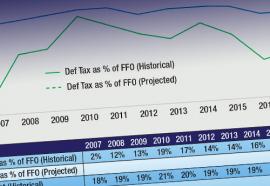
As the industry works to modernize the national T&D infrastructure, utilities are investing dollars that ultimately increase their cost of service—and therefore end-use prices. To cover their investments, many companies are taking a close look at their tax-management policies.

A Prescription for Regulatory Lag

Depreciation accounting methods can trim revenue shortfalls.

Joe Rosebrock

Utilities and regulators are stuck in a rut, treating rate-base assets in a traditional way and depreciating their value according to a straight-line calculation. But alternative accounting methods might provide a more accurate and financially justifiable way to treat depreciation of utility capital assets.

Chasing the $un

Solar projects are becoming hot investments.

Scott M. Gawlicki

With recent scale-up in both photovoltaic and concentrated thermal facilities, solar energy is nearing cost parity with wind and even some fossil generation sources. And with development models evolving to help companies manage technology risks, solar power has become an attractive investment opportunity—not just for tax-equity players, but also for utilities.

Letters to the Editor

(January 2011) Gold Mine or Fool’s Gold?: Debt is recorded on the right side of the balance sheet in recognition that it’s a source of capital, but users of financial statements recognize that it isn’t cash. Likewise, users of financial statements would recognize that moving the book reserve to the right side would not cause it to suddenly become cash.

IFRS and You

How the new standards affect utility balance sheets.

Bente Villadsen, Amit Koshal & Wyatt Toolson

Over the next year (or years), companies in Canada and the U.S. will make the transition towards adopting International Financial Reporting Standards (IFRS). These standards will have a substantial effect on the reporting requirements and financial disclosures of regulated companies. Utilities are preparing their accounting processes to meet a new regulatory standard.

Pages