Calendar of Events

May 21, 2013 to May 22, 2013 | Washington, DC
May 21, 2013 to May 22, 2013 | Charlotte, North Carolina
May 21, 2013 to May 23, 2013 | Atlanta, GA

Keywords

Public Utilities Reports

PUR Guide 2012 Fully Updated Version

Available NOW!
PUR Guide

This comprehensive self-study certification course is designed to teach the novice or pro everything they need to understand and succeed in every phase of the public utilities business.

Order Now

Fortnightly 40 Index

The Fortnightly 40 Best Energy Companies

A challenging year brings a change in the rankings.

By Michael T. Burr

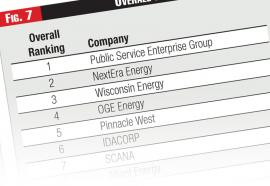
(September 2012) Our annual financial ranking shows some remarkable shifts among the industry’s shareholder value leaders. Despite flat demand and low commodity prices, investor-owned utilities are investing heavily in capital assets. Investment discipline and operational excellence distinguish leaders on the path to financial performance.

The 40 Best Energy Companies

Michael T. Burr

(September 2011) Our annual ranking tracks the publicly traded electric and gas companies that produce the greatest value for shareholders. Despite the year’s topsy-turvy financial markets, perennial performers like DPL, PPL and Exelon return to the top of the list. Others face looming cap-ex burdens as regulators impose new mandates and requirements. Leading companies are positioning for growth, despite a challenging landscape.

The 40 Best Energy Companies

Michael T. Burr

(September 2010) Capital spending and commodity prices are driving changes in financial performance. The 2010 Fortnightly 40 report shows growing success for companies with substantial unregulated assets. As the industry resumes its Big Build, regulatory relationships will determine the long-term strength of utility shareholder returns.

The Fortnightly 40

The 40 Best Energy Companies

Michael T. Burr

(September 2009) The industry’s best companies are weathering the financial storm reasonably well, with the F40 delivering equity returns in the 14-percent range for fiscal 2008. However, falling sales and rising costs are putting heavy pressure on balance sheets—and on regulatory relationships. Companies that balance customer value and shareholder value will be most likely to thrive in the new normal.

Diminishing Returns

Authorized ROEs shrink over time.

Michael T. Burr

This year’s Fortnightly 40 survey showed that while F40 companies have grown their average return on equity (ROE) in the past three years, those returns have grown slowly compared to some other measures—including appreciation in share prices.

The Fortnightly 40

Michael T. Burr

(September 2008) Shareholder value remains strong as the Big Build begins. Our fourth annual ranking shows healthy growth in earnings and share prices. But as capital spending grows, dividends are shrinking and equity returns are weakening. Regulatory relationships will separate future winners from losers.

How to Achieve High Performance

Lessons from the top 40 utilities.

Jack Azagury

(September 2007) A senior executive at Accenture broadens the financial metrics behind the Fortnightly 40 to expound on the high performance behind this year’s ratings—and show the way for utilities aspiring to make the list in future years.

Understanding the F40

How does the modified Dupont Model reward utilities?

By Jean Reaves Rollins

(September 2007) The impact of dividend policies, capital expenditures, and publicly traded equities highlights an in-depth look at what goes into the modified Dupont Model behind the Fortnightly 40 financial rankings for utilities.

The 40 Best Energy Companies

Will 2007 be remembered as the year of the turnaround? Several new CEOs with bold transformation programs took top spots in our third annual ranking.

Richard Stavros

(September 2007) Consistent performance over time is the Holy Grail of corporate management, and a focus of many of the executives who made this year’s ranking. Who returned to the list, and who fell off? And more important, why?

Lies, Damn Lies, and Statistics

How does the DuPont Model—a hybrid of which provides the methodology behind the Fortnightly 40 rankings—actually work? The author shares lessons learned during implementation of the hybrid model this year.

Jean Reaves Rollins

(September 2006) How does the DuPont Model—a hybrid of which provides the methodology behind the Fortnightly 40 rankings—actually work? The author shares lessons learned during implementation of the hybrid model this year.

Pages