

Commission Watch
PJM/Midwest Market:
Should transmission owners get paid extra for distance and voltage?
While the Midwest now appears set...
Power Measurements
Power Measurement
What did LMPs tell us this summer in PJM's new neighborhood?
With one summer under its belt as a member of PJM, ComEd has been called a complete success by some, boring by others. On the whole, prices in the region were quite flat, and spreads between the 1,281 price nodes in the region were small to non-existent. In fact, the best opportunity for a generator to make money in this market was to export power to a neighboring market.
Some of the lack of action this summer surely is due to the fact that it was a cool summer. But from a transmission perspective, it's clear that ComEd was a well-oiled machine. Using data from Energy Velocity's Market Ops and Weather products, we can see the impact of transmission and weather on ComEd this summer.
ComEd's LMP Market
ComEd became part of PJM last May, adding 1,281 new pricing points to the region. To simplify the analysis, we will focus only on peak prices from the real-time market between June and August.
First, the average ComEd zonal price of $40.24, which is a weighted average price for the entire ComEd zone, was 30 percent lower than the equivalent zonal average in PJM of $57.24, shown in Figure 1. Neither market was particularly volatile, but ComEd was as much as 30 percent more volatile than PJM.
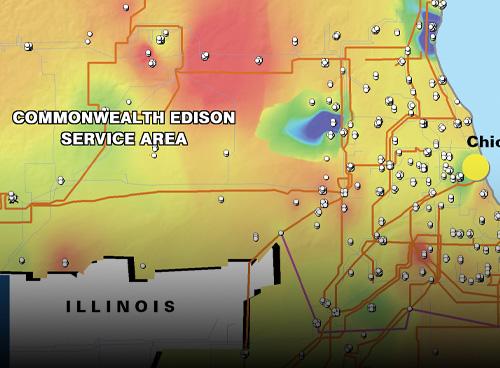
Second, ComEd as a region demonstrated extremely low transmission congestion. Figure 2 presents the average peak prices for the summer by price node. Areas shaded red represent the highest prices and those shaded blue represent the lowest. This figure is useful in presenting the spatial dispersion of prices in the ComEd region. However, a close look at the legend reveals that the regions shaded red are only about $2/MWh higher than those areas shaded blue.
Figure 3 tells a similar story by comparing the spread of congestion prices in ComEd across all 1,281 price nodes and the spread across all price nodes in PJM and PJM West combined. As is clear in the figure, the two regions can't even be compared on the same scale because 99 percent of the average on peak ComEd congestion prices fell between $41/MWh and $44/MWh.
Knowing that the summer as a whole was flat, we decided to search all 2,200 hours of the summer for any hour where congestion might have registered in the LMPs. Significant price differences arose on the grid only from June 6 to June 8. These first days of the summer also brought the first heat wave of the season, which likely caught the market off-guard. While this caused the largest spread of the summer, and some fairly high prices, 93 percent of the LMP locations still demonstrated prices in the relatively narrow band of $80/MWh to $90/MWh.
The spatial pricing trends have implications for the value of location in the ComEd region. It was surprising to see that the highest prices during the summer of 2004 were in the outskirts of Chicago and in the much smaller urban area of Rockford, Ill. But

