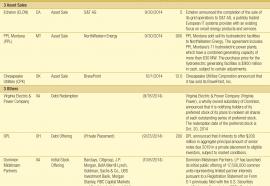
September 2012 -- Southern Company and Turner purchase SunEdison 30-MW PV plant; PSEG acquires 15-MW PV project from Juwi Solar; Duke issues $650 million in 30-year notes; PSE&G floats $350 million; Sempra and SoCal Gas each issue $350 million in bonds; plus bond issues from ONEOK, Regency Energy, ComEd, Tampa Electric, DTE, and Tucson Electric, totaling $4.8 billion.
(July 2011) Williams Partners L.P. expands Transco transmission lines; Google to provide fiber optic Internet service for Kansas City, Mo.; Constellation Energy picks Lynxspring Inc.; plus contracts and developments involving Servidyne, EnerNOC, Siemens Energy and others.
Utility deals resume after 18 months of austerity.
Utilities are taking advantage of a sweet spot in the capital markets, pre-funding and refinancing at record low rates. But cheap money won’t resolve overhanging uncertainties preventing cap-ex projects and M&A deals. Greater certainty in America’s economic and policy outlook will clear a path for strategic change.
Customer-specific demand-response strategies become more sophisticated.
Demand-response technologies are quickly becoming more sophisticated, and markets are treating demand as a resource. But realizing the true potential of DR requires utilities to apply today’s technology solutions and program structures—and to base their strategies on actual customer behavior and preferences—rather than yesterday’s outdated assumptions about centralized load control.
Utilities cut support for climate-change deniers.
Michael T. Burr, Editor-in-Chief
This summer marked the 40th anniversary of a pivotal event in the environmental movement. On June 22, 1969, the oily surface of the Cuyahoga River caught fire, drawing national attention to the plight of America’s lakes and rivers. However, clean water standards didn’t begin with the Cuyahoga River fire, the EPA or the Clean Water Act. A series of common-law nuisance lawsuits, combined with a patchwork of state laws and (weak) federal statutes, preceded the comprehensive legislation that emerged from the smoke of the Cuyahoga. Today we’re seeing a similar progression in greenhouse gas regulation, with civil suits, state initiatives and marginal federal actions apparently marching toward a national climate policy.
In the wake of the banking crisis, utilities lead the way to financial stability.
The back-to-basics trend positioned utilities and other energy companies to lead the way out of Wall Street’s mess. Despite a perfect storm of rising costs and a weakening economy, utilities and lawmakers might start a wave of investments in clean-energy assets and technology. But will Wall Street be ready to finance it?
Volatile markets are causing delays, but most deals are moving forward.
Although problems in the power business grabbed the headlines early this decade, the industry now seems fundamentally strong. In contrast to their ratings of banks, rating agencies appear to have recently upgraded more of the electric sector than they have downgraded. It remains a strong investment grade, usually BB or BBB. For an index of 68 electric utilities, the debt-to-equity ratio averaged only 55:45 and return on equity exceeded over 13 percent through January.
Despite a favorable outlook for utility finance, cost pressures are straining rate structures.
Utilities are bringing monumental capital-expenditure plans before rate regulators just as they’re dealing with a barrage of rising costs—for fuel and other commodities, as well as labor, pension-fund obligations, and interest payments. Ten energy-finance luminaries elaborate on the industry’s fortunes.
Experts predict the top issues that utilities will have to weather this year, and beyond.
Richard Stavros & Michael T. Burr
A soup-to-nuts preview of the next 12 months that touches on spinoffs and interest rates, climate change and New Source Review, the future of nuclear, investor returns, and natural-gas price volatility.
In search of the Holy Grail of utility risk management.
The search is on for the Holy Grail of risk management. Utilities are managing new risks, as more sophisticated systems and services become available.
Pages