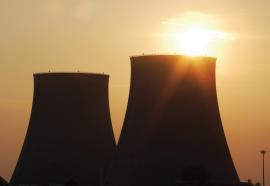
Indian Point and the battle for the nation’s energy future.
John P. Cahill and Joseph A. Edgar
State lawmakers are trying to block relicensing of the Indian Point nuclear power plant near New York City, but the owner hopes to keep the plant generating low-cost electricity. The battle over Indian Point raises new legal issues—and represents a microcosm of the struggle for America’s nuclear future.
Renewing public support after Fukushima Daiichi.
The Fukushima disaster has fallen off the headlines, but fear of nuclear energy remains a potent barrier to new development—as well as continued operation of the current reactor fleet. Building the foundation for a stable industry will require a sustained and strategic approach to restoring and securing the public trust.
Fukushima shockwaves hit America’s nuclear renaissance.
In the aftermath of the March 11 earthquake and tsunami, questions are arising about the safety and survivability of reactors located in geologically active areas. Major changes might be required, and as a result the U.S. nuclear industry might face an existential challenge on the order of the Three Mile Island accident.
State attorneys general target energy policy issues.
Larry Eisenstat, Fred Lowther, Bernard Nash and Divonne Smoyer
As energy issues take center stage in the policy debate, state attorneys general increasingly are using their political influence and legal authority to affect a wide range of areas—from greenhouse-gas emissions to siting and development of infrastructure projects. Working constructively with state AGs can help utilities avoid becoming targets of investigation and litigation.
When Patrick Moore left Greenpeace—the environmental advocacy group that he helped to create in the early 1970s—some activists labeled him a traitor and a corporate shill. It didn’t stop him, however, from becoming one of the environmental community’s most outspoken advocates for nuclear power development—and one of the harshest critics of anti-nuclear activists. Fortnightly caught up with Moore in February to discuss the state of anti-nuclear advocacy in America.
Entergy’s $20 billion spin-off plan elicits yawns on Wall Street
(January 2008)Entergy Corp.’s announced plan to spin off about 5,000 MW of nuclear assets generated a major buzz when it was announced in early November.
A new way to measure what matters most: how close a unit comes to meeting its total potential profit.
Tom Ottem and Michael McNair
Power Measurement
A new way to measure what matters most: how close a unit comes to meeting its total potential profit.
Approximately 65 percent of capacity additions in the last few years have been gas-fired, combined-cycle units. Recent market conditions have been hard on these new resources, which have suffered from significantly low capacity factors. But such units are popular because of their flexibility.
Nuclear power is on the verge of an extraordinary expansion.
John Sillin
The issues facing Entergy's nuclear plant are fixable. Why shut it down?
Donald P. Irwin
For Want of a Nail: Emergency Preparedness at Indian Point
The issues facing Entergy's nuclear plant are fixable. Why shut it down?
What happens when law, technology, and politics collide? It's anyone's guess.
The economic downturn is increasing utility pension plan costs and liabilities.
Richard Stavros
Pension Plans May Slow Utility Growth in 2003
The economic downturn is increasing utility pension plan costs and liabilities.
While 401(k) stock option plans have increasingly displaced traditional pension plans in corporate America, many mature firms like electric utilities are still administering sizeable pension plans that in the recent economic downturn could compromise future earnings, according to a report by investment bank CIBC World Markets (CIBC).
Pages