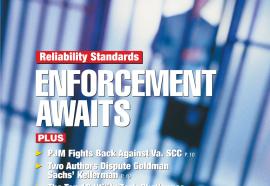
The bias in RTO markets, and how FERC might fix it.
RTO practice creates less risk and uncertainty over the nominal short-term wholesale price of power, but more risk and uncertainty over the long-term cost of transmission. That spells trouble for the coal-fired plant, sited far off at the mine mouth, needing long-haul transmission over a long-enough term to pay back the capital costs.
Consider the opening of the PJM market, and its effect on prices.
Gary Hunt, Doug Buresh, and Mark Turner
Wholesale competition is working, and the best evidence to date is the savings produced from the opening of the PJM market to competitive power generation from the Midwest. A real-time case study unfolded before our eyes in May and October 2004.
FERC must align the immediate self-interest of profit-maximizing entities with its own view of what is in the public interest.
James J. Hoecker & Stephen Angle
Two obstacles must be overcome to achieve true competitive markets: reversal of the long-term underinvestment in transmission, and greater clarity in the legal and regulatory environments. How can the industry make the most of a somewhat defensive regulatory posture?
The Securities and Exchange Commission denies approval of the AEP/CSW merger. What will that mean for industry consolidation?
Dan Scotto
Business & Money
The Securities and Exchange Commission denies approval of the AEP/CSW merger. What will that mean for industry consolidation?
What's wrong the Public Utility Holding Company Act of 1935 (PUHCA)? Perhaps the date! On May 3, 2005, a Securities and Exchange (SEC) administrative law judge (ALJ) handed down a ruling that denied the application of American Electric Power Co. (AEP) seeking approval of its acquisition of Central and South West Corp.
What's behind today's oddball mergers?
Richard Stavros, Executive Editor
Frontlines
What's behind today's oddball mergers?
Look at the gargantuan, gerrymandered service territories you would get with the latest pending merger deals: Exelon-PSEG, Duke-Cinergy, and Warren Buffet's bid to combine PacifiCorp with his MidAmerican Energy. Now ask yourself if they make any sense.
Solving the electricity credit malaise.
Todd W. Bessemer and Francis X. Shields
Solving the electricity credit malaise.
"TCE, a [qualified scheduling entity] QSE in the ERCOT region, filed for bankruptcy protection in March 2003 … the outstanding principal amount owed to market participants at Jan. 1, 2005 is $13,692,188.37. … ERCOT intends to begin the process of uplifting to QSEs representing LSEs the principal amount remaining on TCE's payment obligation to ERCOT. … On Jan. 18, 2005, ERCOT will send invoices totaling $2.5 million to QSEs representing LSEs.
What everybody missed in setting up the regional grids.
Bruce W. Radford
Commission Watch
What everybody missed in setting up the regional grids.
While the electric utility industry has largely agreed on what elements to include in a standard market design (SMD) to govern wholesale power trading in a given region, recent experience shows that the regulators from time to time have overlooked a number of things.
Renewable Energy in the 21st Century:
Philip J. Deutch
Perspective
Renewable Energy in the 21st Century:
State involvement in promoting renewable technologies has profound implications for the future of the energy industry.
Election-year posturing seems to have prevented the federal government from reaching consensus on a number of energy issues ranging from standard market design to global warming, MBTE to Kyoto, ANWR to nuclear waste disposal.
New Opportunities:
We welcome submissions to People, especially those accompanied by a high-resolution color photograph. E-mail to: photos@pur.com
People
New Opportunities:
Dynegy Inc. announced that Carolyn M. Campbell has been named group general counsel-corporate finance & securities, and corporate secretary. Campbell joins Dynegy from Akin Gump Strauss Hauer & Feld LLP.
The need for additional generation to compensate for wind variations is disappearing.
Ron L. Lehr
Technology Corridor
The need for additional generation to compensate for wind variations is disappearing.
Utility-based studies have laid to rest the concern that a wind plant needs to be backed up with an equal amount of dispatchable generation. Even at moderate penetrations, ancillary services to back up new wind power need not be more than is required of a system as a whole.
Pages