Weighing green energy’s costs and benefits.
Michael T. Burr, Editor-in-Chief
Policies aimed at promoting one good thing can diminish a better thing, for a net loss to the overall public welfare. Raising prices to promote renewables, for example, makes electricity less affordable and hurts the economy. But artificially low prices can themselves create social ills — by preserving an unsustainable status quo.
Evolutionary directions for electric system architecture.
Merwin Brown, Lloyd Cibulka and Alexandra von Meier
How will the technology and policy changes now sweeping through the industry affect the architecture of the utility grid? Will America build an increasingly robust transmission infrastructure, or will we rely more on distribution intelligence and microgrids? Scholars at California’s Institute for Energy and Environment analyze various scenarios to predict the possible futures.
State regulators face mandates without consensus.
Lynne Holt and Mary K. Galligan
New federal and state policy mandates are pulling state regulators in many directions. The patchwork of regulations has created a new level of complexity for utility investment decisions and political risk for utilities and state regulators alike.
Local communities welcome new reactor projects.
Visitors to Waynesboro in northeast Georgia might be surprised at local residents’ opinions about two new nuclear energy plants planned for that site; namely, they’re giving the reactors a warm welcome.
Perception trumps reality at Florida ‘solar city.’
Michael T. Burr, Editor-in-Chief
Once upon a time, a real estate developer dreamed of building a planned community. The developer, Syd Kitson, envisioned a “city of tomorrow™” in southwestern Florida, designed for efficiency, convenience and harmony with nature. Instead of driving cars everywhere, the 45,000 residents of Kitson’s Babcock Ranch would ride bikes to school, and walk to the cinema. They’d take a tram to visit friends in another hamlet, on the other side of a lush wildlife preserve.
The Southeast again is the battleground for fuels, technology, and market structure.
One sure sign of recovery in boom-and-bust power-generation markets is the renewed growth in the planning and construction of power plants. Active efforts are underway in generation development in the Southeast markets in spite of the high levels of generating reserve margins. With its traditional utility-dominated market structure and a preference for baseload generation, the Southeast is the battleground for the next round of power-generation development.
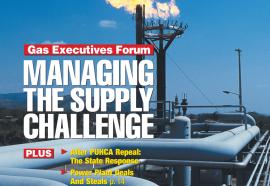
The search for supply goes global, for better or worse.
George Given, Gary L. Hunt, and Mike Donnelly
The expected increase in gas consumption for electric generation and high commodity prices has fueled a renewed interest in developing more LNG and other non-conventional resources (coal-bed methane, tight sands and shales, Arctic gas)
The models and motives behind tomorrow’s transmission expansion.
Major transmission projects based on two distinct models are showing signs of life. What can these projects teach us about future transmission investment?
Budgets are expected to increase, even as new IT challenges present themselves.
In our annual technology forum, we talk with tech/information specialists at four companies: Patricia Lawicki at PG&E; Ken Fell at the New York ISO; Mark C. Williamson at American Transmission Co.; and John Seral at GE Energy.
Congress revamps LNG and storage, giving broad new powers to FERC. Why the Feds still must consult with local authorities.
A major objective of the Energy Policy Act of 2005 (EPACT) is to counter the worsened conditions in the natural-gas market that began in 2000 and are expected to continue over the next several years—namely, tight natural-gas supplies and high, volatile gas prices caused by a distinct shift in the supply-demand balance. Any noticeable reductions in gas prices that might be effectuated by the act will have little impact on natural-gas prices for a number of years.
Pages