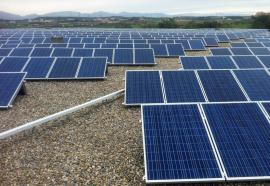
As tax equity investors are moving away from renewable power facilities, political and market forces are creating the need for additional project financing. Fortunately, three non-traditional capital vehicles offer low-cost financing alternatives.
Three CEOs, three business models, one shared outlook.
Cheap gas, regulatory uncertainties, and a technology revolution are re-making the U.S. utility industry. Top executives at three very different companies—CMS, NRG, and the Midwest ISO—share their outlook on the industry’s transformative changes.
Preparing the grid for large-scale renewables.
With large solar arrays and wind farms being proposed to connect to transmission and sub-transmission systems, are utility companies sufficiently prepared to handle the challenge of integrating these large intermittent resources? The industry now must decide whether transmission reliability factors — most notably dynamic voltage support and system frequency management — need to be resolved by renewable generators, or whether they should become a cost of doing business for transmission providers and reliability coordinators.
Integrating renewables in New York.
New York has developed new market mechanisms intended to effectively incorporate large amounts of renewable energy in the future — up to six times the current levels of intermittent energy without impacting system reliability. New York ISO executive Rana Mukerji explains how the market will drive new investment in renewable energy in the state.
Understanding the value of pumped storage.
Pumped-storage technology allows utilities to defer the time value of energy, but project developers have struggled to make their economics work. Increased demand for ancillary services and standby capacity might make pumped storage more viable.
As green mandates tighten, utilities scramble to comply.
Mandatory renewable portfolio standards are becoming the norm. But after low-hanging green fruits are harvested, renewable power might get scarce. Many utilities will struggle to meet RPS requirements until lawmakers create stable federal policies and a national market for green credits.
The current coal bust might lead to a future boom.
Gary L. Hunt and Hans Daniels
Coal is taking a beating. As mining costs rise, coal reserves deplete, emission regulations strengthen, and inter-fuel competitive dynamics change, the allocation of coal in the electric generation industry is certain to see substantial changes. The uncertainties over CO2 regulations and emissions standards are having a chilling impact on both proposed and current coal investment.
The complex financial analysis that has driven renewable energy investment has become the standard for assessing all potential electric generation investments.
Tax incentives, renewable portfolio standards, and the creation of renewable-energy credits and carbon constraints are no longer separate considerations when assessing renewable-energy projects. The convergence of these economic considerations will affect the value proposition for every potential generation investment in the United States.
The treacherous journey toward a more efficient and transparent Northwest power market may be nearing its conclusion.
Michael T. Burr
The treacherous journey toward a more efficient and transparent Northwest power market may be nearing its conclusion.
Steve Wright stands at the helm of an agency with a seemingly impossible task. As CEO and administrator of the Bonneville Power Administration (BPA), Wright must serve a broad spectrum of interests, from aluminum smelters to sockeye salmon. And no matter what he or anyone does, it's impossible to make them all happy at the same time.
State government may have done more for wind power than PTC ever did.
Dr. Jeff Price
Pages