

Public Utilities Reports

PUR Guide 2012 Fully Updated Version

Available NOW!
PUR Guide

This comprehensive self-study certification course is designed to teach the novice or pro everything they need to understand and succeed in every phase of the public utilities business.

Order Now

Vendor Neutral

April 2012
This full article is only accessible by current subscribers. Please login to view the full content.
Not a subscriber yet? Click here to subscribe for one year of Fortnightly Magazine, and gain access to the entire Fortnightly article database online for you and three of your coworkers.

Generation

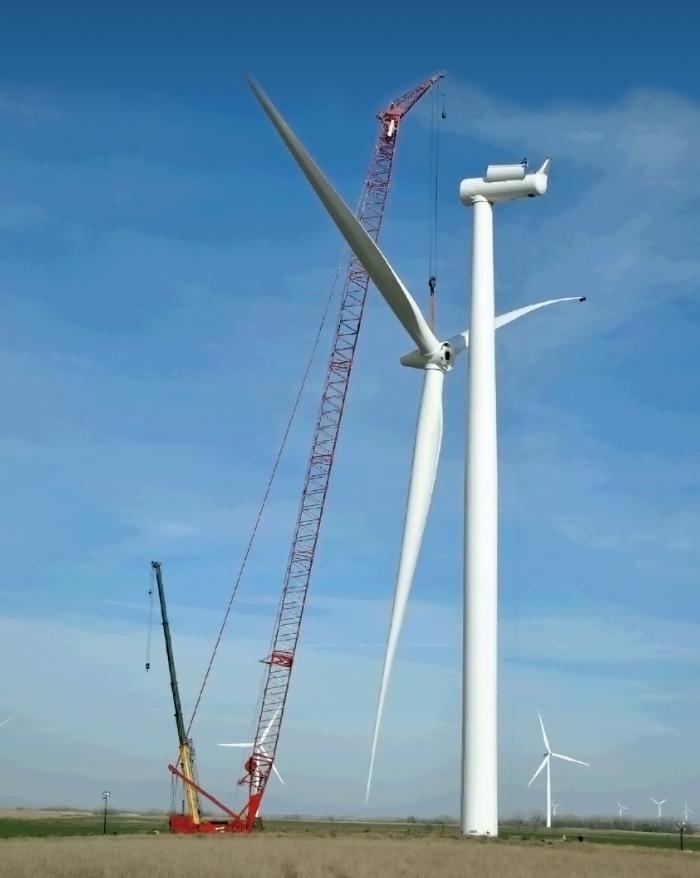
Siemens is supplying SWT-2.3-108 wind turbines for MidAmerican Energy’s 407-MW expansion project in Iowa.

MidAmerican Energy awarded a contract to Siemens Energy to supply wind turbines for its 407-MW project expansion.  Siemens will supply 176 turbines to be installed at four sites in Iowa. The orders follow the completion of Siemens projects in Iowa exceeding 593 MW of wind capacity. Siemens is expected to provide SWT-2.3-108 turbines for MidAmerican’s 103.5-MW Vienna project, to be located in Marshall and Tama counties; its 200.1-MW Eclipse project in Guthrie and Audubon counties; the 101.2-MW Morning Light project in Adair County; and one 2.3-MW turbine at the Rolling Hills project. The contract includes a five-year service, maintenance, and warranty agreement. The nacelles and blades for the turbines will be manufactured at Siemens’ facilities in Fort Madison, Iowa, and Hutchinson, Kan.

American Electric Power began operating the 580-MW Dresden natural gas-fired combined-cycle power plant. AEP purchased the partially built Dresden plant from Dominion Resources in 2007 for about $85 million. AEP accelerated construction in January 2011. Total costs for the plant were about $366 million. The Dresden plant will supply electricity to AEP’s Appalachian Power customers in West Virginia, Virginia and Tennessee.

Duke Energy and ChinaHuaneng Group signed a three-year agreement expanding their research cooperation to include coal and carbon capture and sequestration technologies. The companies initially signed a memorandum of understanding in 2009 to share information on renewable and clean energy technologies. In 2009, Huaneng developed a facility that economically captured 120,000 tons of the carbon dioxide per year emitted from the 1,320-MW coal-fired Shidongkou power station. The expanded agreement calls for an engineering study to determine the potential feasibility of applying Huaneng’s carbon capture process at unit 3 of Duke’s Gibson station in Indiana. The U.S.-China Clean Energy Research Center is providing funding for the collaborative effort.

AEP started operations at its 580-MW Dresden gas-fired combined cycle plant.

Macpherson Energy and DTE Energy Services (DTEES) completed their project to convert the Mt. Poso cogeneration plant in Kern County, Calif., to rely entirely on biomass fuel—primarily urban and agricultural wood waste—instead of coal. Starting in November 2011, one year after the conversion project began, the plant began delivering 44 MW of capacity to the California grid under a long-term power purchase agreement with Pacific Gas & Electric. The plant also produces steam for enhanced production at a nearby oil field owned by Macpherson Energy. JPMorgan Chase provided tax credit financing for the project.

The University of Minnesota awarded a design services contract to Jacobs Engineering for the decommissioning, historic preservation, and construction of the Old Main Utility Building (OMUB) power plant in Minneapolis. A 14-MW gas-fired power plant will augment an existing coal-burning facility to provide electricity and steam for the university campus. The project will cost $81 million.

The Next Generation Nuclear Plant (NGNP) Industry Alliance selected the Areva Generation IV reactor concept as its design for next-generation nuclear plants. The high-temperature gas-cooled reactor (HTGR) is intended to provide an inherently safe and secure design by ensuring no internal or external event could cause a release of radioactive material. Areva says the HTGR’s modular design would support applications in power generation, petrochemicals, unconventional oil recovery, and synthetic fuel production.

Siemens

This full article is only accessible by current subscribers. Please login to view the full content.
Not a subscriber yet? Click here to subscribe for one year of Fortnightly Magazine, and gain access to the entire Fortnightly article database online for you and three of your coworkers.