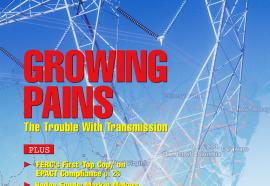
After closer study of the technology’s ongoing implementation and obstacles, the crystal ball remains cloudy.
By Christian Hamaker
What will it take for broadband over power line (BPL) technology to take hold? Is BPL on track to become, as the National Association of Regulatory Utility Commissioners (NARUC) once contemplated, the “third broadband pipe into residential consumers’ homes, providing significant competition for cable and DSL service,” and an integral part of the 21st century “smart grid”?
Banks are reshaping the energy-trading landscape. When the dust settles, utility companies will face different strategic horizons.
Utility executives face volatile energy markets, skyrocketing fuel prices, and changing federal energy policies. How are utilities benefiting from the turnaround in energy trading?
All systems are Reddy.
Miscellaneous distribution operations expenses totaled $878 million in 2004— the largest single element of the distribution operations expenditures. Greater integration of real-time data can bring such costs under control.
In the near future, the majority of investor-owned electric utilities will request, and ultimately win, rate increases. What can utilities do to alter consumer perceptions of higher bills?
FERC says it won’t ‘change’ the native-load preference, but don’t bet on it.
When FERC opened wholesale power markets to competition a decade ago in Order No. 888, it codified a system for awarding grid access known as the pro forma Open-Access Transmission Tariff (OATT), founded on physical rights, and on the fiction that electrons travel along a “contract path.” Should the commission “tinker” with the OATT, making only surgical changes to make it current? Or, do events instead warrant a complete overhaul?
Let's enjoy this brief period of diminished acrimony before implementation of this landmark law.
In a time of record high gasoline prices, war, and increasingly shared global climate concerns, it is lamentable that the Energy Policy Act of 2005 does so little to address these critical issues. Within the narrower context of policies primarily affecting the electric power industry, however, this is a much more significant piece of legislation, and it includes a few accomplishments bordering on the extraordinary.
Recent attrition raises the question: Consolidation or death spiral?
Michael T. Burr
Recent attrition raises the question: Consolidation or death spiral?
When GridAmerica LLC closes its doors at the end of this year, the number of independent transmission companies (transcos) in the United States will fall by one-fourth. Only three ITCs will remain: American Transmission Co. (ATC), International Transmission Co. (ITC), and Trans-Elect Inc.
No single type of financial incentive closes the cost gap between clean coal and modern conventional coal technologies.
Thomas Wilson and Charles Clark
No single type of financial incentive closes the cost gap between clean coal and modern conventional coal technologies.
After two decades of demonstration projects aimed at establishing the technical and economic viability of clean-coal technologies, a variety of power producers now are considering seriously their use for new commercial generating plants.
IOUs considering co-op acquisitions are finding fertile territory for growth.
Kevin T. Williams
IOUs considering co-op acquisitions are finding fertile territory for growth.
When utility executives consider the options for growing their business within a "back-to-basics" framework, naturally they consider acquiring other utilities. However, the relatively high price/earnings ratios of most investor-owned utilities (IOUs) today means bargains can be hard to find.
Data gathering and controllability offer the quickest path to reliability.
Michael T. Burr
IT Roundtable
Data gathering and controllability offer the quickest path to reliability.
Managing power grids in North America has become much more complicated in recent years, and that complexity grows with each passing day.
Pages