

Key to Low-Carbon Future
Mark A. Gabriel is CEO of the Western Area Power Administration.
Western Area Power Administration (WAPA), part of the Department of Energy, is responsible for selling hydropower generated at fifty-seven federal hydroelectric dams in the western U.S. to about seven hundred long-term preference power customers in fifteen states.

Our customers, in turn, sell this at-cost, renewable, reliable hydropower to support the energy needs of more than forty million Americans. In addition to marketing hydropower, we also own, operate, and maintain an extensive high-voltage transmission system that is one of the top ten largest systems in the U.S.
Hydropower is one of eight purposes behind the federal dams. Each individual dam may not support all the legislated purposes, but typically they are multipurpose projects, supporting hydropower, navigation, flood control, irrigation, recreation, fish and wildlife, water quality, and water supply.
Hydropower is the proverbial goose that laid the golden egg: it pays for itself through power rates, but also supports the other critical missions of the dams. WAPA's power rates cover our own annual operations and maintenance as well as that of the generating agencies and pay for the original federal investment in the dam, plus interest.
Each year, we provide millions of dollars to the U.S. Treasury to meet repayment obligations for the water and power infrastructure. WAPA power rates also cover shortfalls if irrigators are unable to pay for their share of the water.
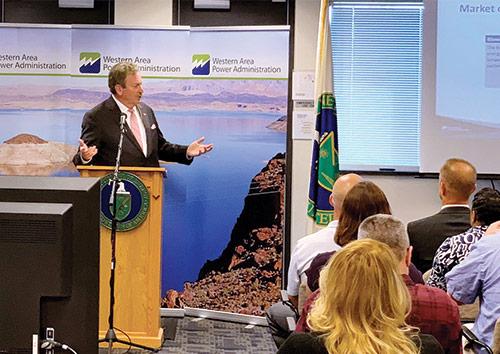 Mark Gabriel giving a speech.
Additionally, WAPA's power rates support environmental programs throughout the Colorado River Basin and the Central Valley Project. If it were not for WAPA's contributions, programs like the Central Valley Project Improvement Act and the Glen Canyon Dam Adaptive Management Work Group would cease to exist.
It would be fair to say that these dams would not be built solely for hydropower, but the dams and all the benefits they provide, including preventing catastrophic flooding, would not exist without hydropower.
Hydropower Generation
Hydropower is one of the largest generators of clean, renewable electricity, representing seven percent of total U.S. electricity generation and thirty-nine and a half percent of renewable electricity generation in 2018.
The U.S. hydropower fleet is comprised of approximately twenty-two hundred power plants with a total capacity of roughly one hundred and two gigawatts, which includes ninety-five percent of U.S. storage capacity (twenty-three gigawatts) pumped storage. Hydropower is also a major job creator, employing sixty-six thousand and five hundred workers.
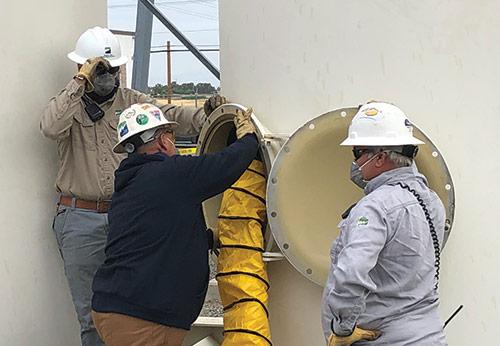 WAPA electricians and linemen replaced a breaker in the Elverta Substation in northern California in May while following appropriate measures to keep each other safe from COVID-19.
We do not need less hydropower; we need more. Only three percent of dams in the U.S. produce hydropower, which is a massive lost opportunity for more renewable and reliable clean energy to be added to the grid.
Even if we did nothing but preserve the existing fleet of hydropower, from 2017-2050, the DOE Hydropower Vision study predicts our country collectively will have avoided 4.9 billion tons of carbon release, saved thirty trillion gallons for water, and saved fifty-eight billion dollars in avoided mortality, morbidity, and economic damages from the reduction in emissions, and that is on top of the benefits to date. As it stands, hydropower avoids about two hundred and twenty-five million metric tons of carbon pollution in the U.S. this year, equivalent to the emissions of forty-two million passenger cars.
Hydropower Key to Grid Stability
In the energy world, hydropower's role is even more important in a world of increasing renewables as it is a tremendous renewable, low-carbon emitting resource. It is increasing in value as traditional fossil generation sees its last days, especially in the Western U.S.
Large, rotating mass, not just energy, is necessary to maintain grid reliability and provides critical capacity resources. This mass cannot be met by intermittent resources, which provide only energy, and on average, at less output than nameplate capacity.
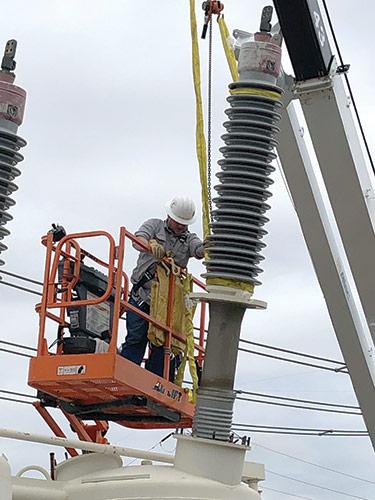 WAPA lineman working on a substation in the Central Valley Project in northern California.
Our options to accommodate increasing intermittency in the balancing authorities without hydropower are quite limited. In reality, all BA operators are faced with buying more generation from fossil fuels as the quantity of non-hydro renewables increases. This brings us to the question of energy versus capacity and a world where energy is free most of the day and capacity is undervalued and underappreciated.
This is what we call the carbon/capacity conflict. Average wind output is twenty-five to thirty-three percent of nameplate capacity; solar only twenty-five percent. A two thousand-megawatt wind or solar farm cannot match the output of a two thousand-megawatt coal plant, which averages generation at more than ninety percent of nameplate capacity.
In more relatable terms, if the energy industry could be equated to the world of computers, baseload resources are servers — either in a server farm or in the cloud — while renewable resources are memory sticks. The grid is the network.
The number of computer servers are declining radically while everyone is running around with their memory sticks trying to plug them into the network as quickly as possible. But you cannot run a network off memory sticks any more than you can run the grid off renewable energy alone.
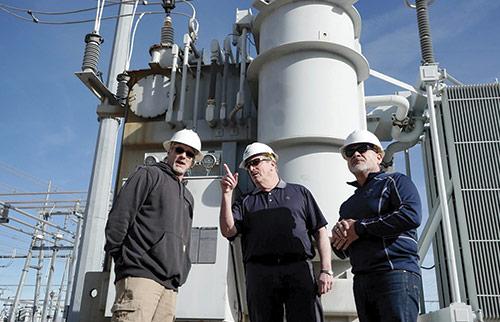 Mark Gabriel, center, out in the field.
As hydropower is one of the main remaining computer servers — a supercomputer even, given its unique black start capabilities and low-carbon emissions — how do we ensure the capacity, reliability, black start capabilities and other operational benefits — ignored in today's market structure — are appropriately and adequately compensated?
Hydro Partners with Intermittent Resources
As a baseload resource, hydropower helps provide stability to the increasing fragility on our grid as other large inertial masses leave the system, such as coal and nuclear. Hydropower also possesses flexibility in its ability to ramp up and down generation as needed, while solar and wind are generally an all-or-nothing deal. The ramping capability and quantity of hydropower is unmatched by any other resource.
Hydropower continues to be the ideal partner to wind, solar, and potentially battery storage, which makes sense as hydropower is the original battery storage project. The reservoir — that great bastion of recreation, wildlife, fishing, and water supply, serves as a ready and waiting source of electrical energy far superior to the lithium ion batteries today.
A one-megawatt battery the size of a tractor trailer can provide four hours of uninterrupted energy before exhausting its supply. Replacing even a two thousand-megawatt coal plant would require twelve thousand tractor trailers to provide the same output for a single day.
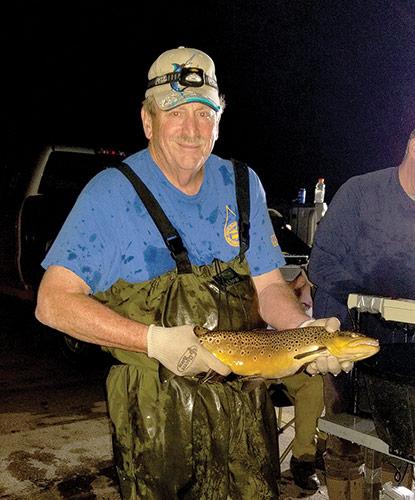 Mark Gabriel taking part in a fish survey.
As we have seen in our participation in the Southwest Power Pool market, hydropower is providing backbone base resources that allows for system stability, moderating costs to consumers and improved river and dam operations. In fact, much to our surprise when we entered the market in 2015, hydropower acts as a base resource allowing wind to capture more and more of the energy component.
We anticipate seeing this across the west as the energy imbalance market in California and the SPP Western Energy Imbalance Service expand their footprints. This is especially important as increasing numbers of coal units close, challenging the capacity to ensure grid stability.
The challenge for society is to quantify the value of hydropower beyond traditional means, which places preeminent value on energy. The challenge is exacerbated by the current crash of spot market prices, which pressures fossil resources to disappear and take with them their carbon and related issues but also their value in keeping the lights on.
Mass Power Outages and System Disturbances
Beyond the value of hydropower to grid stability, it is also the key and very necessary element for grid resilience and the often-unrecognized issue of black start should a power failure occur. During major power system disturbances, there is the possibility of large area blackouts similar to the northeast outage in August 2003 or the southwest outage in 2011.
During these events, power plants can trip offline due to numerous control actions and cannot be restarted until power is restored to the facility. In order to provide this startup energy, utilities have identified plants that can provide their own power through emergency on-site generators. These plants are referred to as black start units. In the western U.S., these capabilities are frequently provided by hydropower.
Hydroelectric plants are common black start units and may use a small manually operated hydro, gas, or diesel generator started by the plant operations staff. The staff use that local power to provide minimal services to the facility to operate critical systems. At a hydroelectric plant, the generator would run oil, cooling, and control circuitry so that the wicket gates at the hydroelectric plant may be opened to allow water to spin the turbines and restart the hydroelectric generators.
Once the hydroelectric facility has been brought online, transmission system operators take over and piece the transmission system back together in order to supply power to other generators to return them to service.
Despite increased grid fragility due to changing generation mix, more and more non-hydro black start units are being removed from the system due to increased costs and regulatory requirements.
Meeting regulatory requirements is a critical challenge for the reliability of the nation's electric grid, and in particular, the nation's remaining nuclear plants that require a stable source of electricity to restart generation.
Hydropower and National Security
Hydropower is also critical in terms of national security, providing black start capabilities, resiliency, and direct power supply to many of the nation's military bases and national laboratories. In WAPA's case, we supply power to more than thirty military bases and other highly sensitive facilities across the west. In addition, many of our customers similarly are conduits of the power to the bases and national security facilities.
As part of the Defense Critical Electric Infrastructure Program, we have been working with the Department of Defense to secure direct feed power to the most critical bases in the west. A great example is Beale Air Force Base in California, which today is served by a single line, yet is less than three miles from a two hundred and thirty kilovolts transmission line bringing in power from the Central Valley Project.
We are supporting their interconnection request to the two hundred and thirty kilovolts line to provide redundant, reliable power to Beale and its critical missions. Beale, like many military installations, is also adding solar and storage to their resource mix, but there is a significant time and fuel limitation.
Conclusion
All forms of energy generation have environmental drawbacks, and the subjective severity of those impacts varies depending on the priorities of who you ask. Hydropower is no different, and its effects have been well documented over the decades the dams have been in operation supplying all of us with drinking water, irrigation water, life-saving flood control, improved transportation, fun and of course, hydropower.
From a conservationist perspective, it is important to continue the dialogue to balance and limit the effects the dams have on the surrounding ecosystem while preserving the value the dams provide Americans.
Hydropower is the ultimate generation source, providing both grid stability and low-cost and renewable energy, which is a combination not present in any other form of electric generation today.
Hydropower proponents see themselves as part of the climate change solution, not part of the problem. My employees, as a whole, are proud to be part of an organization that provides the country the original renewable generation; we are proud to be green and environmentally friendly.
Our main challenge for humanity today is reducing the carbon emissions due to our existence on this planet. If we do not wrangle emissions, and their impact to health and air, water, and soil quality, attempting to save individual species or ecosystems will not result in long-term conservation success.
Hydropower is key to a low-carbon future while maintaining the same electric reliability our lives and economies depend on. Electricity is not a luxury; it is a necessity, and some argue, a basic human right. The challenge hydropower proponents and environmentalists should solve together as part of the larger climate problem, is how do dams and ecosystems co-exist in a viable manner?
