

Reconductoring
Jason Huang is founder and CEO of TS Conductor, a U.S. manufacturer of next generation advanced conductors that enable utilities to increase capacity while reducing project costs and saving customers money. His career spans senior leadership positions at companies like CTC Global, BAE Systems, Owens Corning, and Solvay, as well as work with the National Institute of Standards and Technology and on critical defense aircraft projects.
Let’s be honest. Some grid operators are still under the impression that reconductoring with advanced conductors is expensive. The data tell a different story. In fact, the reality is the exact opposite; today’s advanced conductors yield net savings.

This is important to understand, because if grid operators overlook advanced conductors because they think they’re too expensive, they’re limiting their ability to address challenges that are only becoming more acute, especially when it comes to grid modernization and capacity expansion.

It’s a familiar story. America’s transmission infrastructure is aging, and significant new capacity is needed to meet growing demand and alleviate bottlenecks. Spending on transmission nearly tripled from 2003 to 2023. But a lot more is needed at a time when twenty percent of Americans are struggling with utility bills, and ten percent have received disconnect notices in the past twelve months.
Utilities need an affordable way to meet demand sooner rather than later by getting more out of their existing transmission corridors. Reconductoring with advanced conductors makes that possible by delivering more capacity and contrary to popular belief, with less CapEx.
More Capacity, Less CapEx
ACSS is commonly used for reconductoring projects today, but it comes with a significant drawback – thermal sag. When operating at higher temperatures to achieve increased capacity, ACSS conductors sag substantially. This often requires utilities to raise structure heights, strengthen crossarms, and/or modify foundations, which are expensive and time-consuming structure retrofits that dramatically increase project costs.
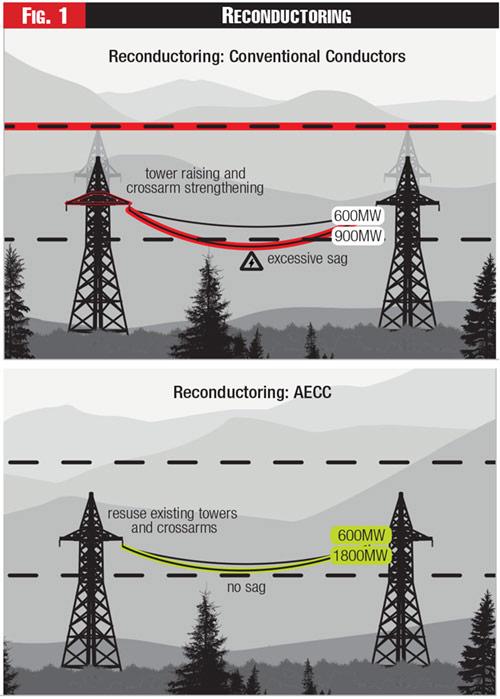 Figure 1 - Reconductoring
Advanced conductors solve this problem by enabling capacity increases without structural modifications. Their low thermal sag allows utilities to use existing structures while still achieving two to three times the capacity of traditional ACSR.
The time and money saved on structures more than offsets the modest price premium of the conductor itself, resulting in overall project cost reductions up to thirty to forty percent compared to traditional reconductoring approaches. The result is a simple equation – more capacity with less capital expenditure.
See Figure 1.
Savings in Action
Recognizing its advantages, respected utilities across the country are adopting advanced conductor technology for major reconductoring projects.
In March 2021, Montana-Dakota Utilities completed an eleven-mile advanced reconductoring project on its two hundred thirty kilovolt transmission line in North Dakota. The project increased the line’s operating ampacity by seventy-eight percent, achieved 1.8 million dollars in savings, and was completed a full year ahead of schedule, minimizing both construction costs and service disruptions.
More recently in April 2024, Salt River Project (SRP) completed an eight-and-a-half mile advanced reconductoring project in Phoenix, Arizona. The project allowed SRP to maintain the fifty-year remaining service life of existing structures while reducing outage-related expenses and still achieving the significant capacity increase needed for growing demand.
Reliable Grid Future: Affordable Way to Invest
Today’s utilities are tasked with providing safe, secure, and affordable energy. Reconductoring with advanced conductors is the key to fulfilling that objective on terms that make sense now, and into the future.
In the next article in this three-part series, we’ll discuss why advanced conductors are not just for reconductoring. They can also provide the most affordable and effective option for new transmission buildout.
