

EPRI’s DCFlex Initiative Tackles the Challenge
David Porter is EPRI’s Vice President, Electrification and Sustainable Energy Strategy.
The digital economy is accelerating, and artificial intelligence (AI) is the engine driving it forward. From automated manufacturing to personalized health care and real-time language translation, AI promises to reshape industries and improve daily life.

But the infrastructure supporting that transformation is facing a significant surge in electricity demand. Enter DCFlex, EPRI’s three-year initiative to operationalize flexibility in data center electricity use and better align digital growth with grid capacity.
From Modeling to Reality
What sets DCFlex apart is its emphasis on field demonstrations, not just models and theories, but real-world validation. The initiative’s first three living labs are bringing together industry partners to test flexibility solutions under operational conditions.
Three demonstrations are currently underway:
Sites 1 and 2 are exploring computational flexibility – how AI workloads can be intelligently scheduled or shifted to reduce peak load without degrading performance. Site 3 examines how a data center responds to power quality events, helping to establish best practices for reliability and resilience by providing ancillary services to the grid.
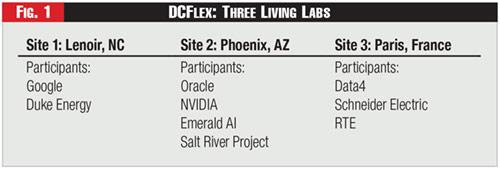 Figure 1 - DCFlex: Three Living Labs
See Figure 1.
The selection process for additional sites is ongoing, with more pilots expected to launch later this year. Future demonstrations will expand into evaluating low-carbon backup generation, including biodiesel, renewable natural gas, hydrogen, and thermal storage, as part of a cleaner, more flexible backup energy supply.
A Shared Opportunity
DCFlex brings together a powerhouse coalition: hyperscalers like Google, Microsoft, and Meta; tech companies like NVIDIA and Schneider Electric; utilities, grid operators, data center developers, and equipment manufacturers. By identifying and testing real-world solutions that allow data centers to become grid-responsive, the coalition seeks to enable AI’s growth without compromising electric system reliability or affordability.
DCFlex collaborator Google recently announced it’s addressing the growing energy demands of AI by incorporating flexible demand capabilities into some of its operations — a strategy that allows its data centers to shift or reduce energy use during peak grid times.
In partnership with several utilities, Google is testing demand response strategies that target machine learning workloads, which shows significant potential to manage AI-driven load growth in regions with limited grid capacity.
Google acknowledges that not all data center functions can be flexible due to computational needs, but by working with utilities in long-term energy planning, Google sees a significant opportunity to expand its demand response toolkit and help manage AI-driven growth, especially where power generation and transmission are constrained.
In a separate field trial at the Arizona demonstration site, Emerald AI successfully mapped which AI tasks can be slowed, paused, or relocated, allowing data centers to reduce power consumption during times of grid stress.
This trial showed an AI compute cluster could reduce its power consumption by twenty-five percent over a three-hour peak system event without compromising essential data center services. This kind of demand-side response could become a key tool for utilities navigating tight capacity margins. According to the project summary, this flexible model has the potential to unlock massive grid capacity.
These trials illustrate how AI factories can become part of the energy solution. By tapping existing energy resources in a more flexible and strategic way, the pilots also demonstrate a solution that could enable the next generation of data centers to come online sooner, rather than waiting for generation or transmission construction to handle more load.
Building the Framework for the Future
The outcome of DCFlex won’t be limited to a few successful pilots. EPRI aims to develop a framework of standards, best practices, and tools that can be adopted industry-wide, streamlining interconnection processes, reducing delays, and enabling wider adoption of flexibility at scale.
To address the immediate timing gap between data center development and capacity expansion, DCFlex recently added a fourth workstream. With a focus on data center-informed energy supply, this track explores quicker pathways for data centers to access more power with both front and behind-the-meter options, like energy storage, flexible backup generation, and localized grid enhancements.
This would be especially relevant for hyperscalers that need AI-driven data centers in a specific location for business purposes, but the area is already capacity-constrained. DCFlex’s first three workstreams address flexible data center design and operation, utility engagement and incentives, and integration of tools and forecasting. For more on workstream activities, see the video at https://dcflex.epri.com/.
The DCFlex initiative is working to give the energy and tech sectors a shared roadmap to scale responsibly and sustainably. With guidance on designs, incentives, and collaboration, the sectors can be active partners in supporting a resilient and affordable power system. In today’s AI economy, data centers are not just energy users; they are transforming energy into unprecedented economic growth.
