

Energy Impact Partners
Evan Pittman is Head of Innovation at Energy Impact Partners. Anthony Oni is Elevate Future Fund Managing Partner at Energy Impact Partners.
Thought leaders in the energy and utilities industry are forecasting that 2026 will be a critical year dominated by pressure due to massive load growth from data centers, artificial intelligence, and onshoring of manufacturing. Surging power demand from data centers and electrification efforts are expected to test the limits of existing generation and grid infrastructure.

Maintaining reliability will be a top concern and this explosion in demand is also causing affordability challenges. But AI that is helping cause these issues is also being looked at as part of the solution.
Public Utilities Fortnightly Executive Editor Steve Mitnick turned to four experts facing the challenges and opportunities ahead in 2026. Guidehouse Global Energy Providers Practice Leader Michelle Fay, Emerson President of Power and Water Solutions Bob Yeager, and Energy Impact Partners Head of Innovation Evan Pittman with EIP Elevate Future Fund Managing Partner Anthony Oni provided their thoughts on what the new year will bring.
PUF’s Steve Mitnick: What can the energy and utilities industry expect to see and be challenged by in 2026?
 Evan Pittman: The focus on execution in 2026 has to be coupled with innovation. It’s an unprecedented moment for utilities to seize a generational growth opportunity. But yesterday’s technologies and business practices won’t get us there at the pace we need.
Anthony Oni: I believe 2026 is going to be the year of execution under real constraints, with speed to power and affordability at the center of the conversation. We’ll see large industrials and data centers funding major infrastructure because time to energization now matters as much as cost.
For speed to power, identifying viable bridge solutions is crucial. Flex capacity is going to be a big deal. Generation, especially distributed generation, is where we’re seeing a lot of uptick. Additionally, improving transmission and the interconnects is a big piece of the puzzle.
One of the major challenges utilities are going to face is on the permitting side with the timelines. They’ve had challenges there for quite some time but now there’s more pressure.
These permitting challenges can stretch for decades, but they’re colliding with very real near-term demand. That pressure is only going to increase, which brings us back to the focus on speed to power.
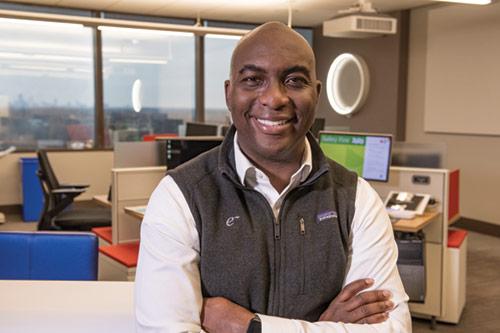 Anthony Oni: 2026 is going to be the year of execution under real constraints, with speed to power and affordability at the center. We’ll see large industrials and data centers funding major infrastructure because time to energization now matters as much as cost.
It’s why bridging solutions like Enchanted Rock matter. Their onsite microgrids and resiliency-as-a-service model allow critical facilities and large new loads to secure reliable power quickly, bypassing long interconnection and transmission timelines.
That enables customers to come online faster while the broader grid and permitting processes catch up. And once the connection does come, those resources can continue to serve as back-up for the host and peaking capacity for the utility.
The other constraint we’ve talked about in the past, which has become more pronounced, is workforce. Skilled labor is huge. Think about all the infrastructure that needs to get built.
We’re trying to build the next generation of energy infrastructure without the workforce that built the last one. That means we have to rethink how quickly we upskill, reskill, and build new skills at scale.
Ultimately, it’s a focus on execution, a more programmatic approach around all the above in terms of different capacity needs that will have to be met. In 2026, the defining question won’t be what technologies utilities believe in. It will be how quickly can they get steel in the ground and power on the system while keeping energy affordable.
Evan Pittman: Anthony summed it up well. As I reflect on the industry gatherings I’ve been at over the last couple of months and look ahead to 2026, despite all the complexity, it’s never been simpler to summarize what the priorities are, and that’s speed to power and affordability.
I’ll add that the focus on execution in 2026 has to be coupled with innovation. It’s an unprecedented moment for utilities to seize a generational growth opportunity and to step up to meet a critical challenge for society. But yesterday’s technologies and business practices won’t get us there at the pace we need.
I’m confident the utilities are up for the challenge. We see firsthand the energy they’re putting into this every day. It’s imperative right now to make sure that sense of urgency permeates throughout the entire utility organization and there is a move toward a “how can we” mindset when new challenges and new ways of doing business present themselves.
PUF: What role do you expect Energy Impact Partners to play as the energy and utilities sector takes on these challenges?
Evan Pittman: The two core values for EIP all along have been collaboration and innovation. These days, we can be more specific and say we’re laser-focused on broad collaboration and practical innovation.
When it comes to broad collaboration, the utility industry’s always been great about sharing best practices and coming together. It’s a uniquely positioned industry to do that, but it’s time to stretch even further.
We can’t expect to effectively integrate this new wave of large loads without radically transparent dialogue and coordination from both sides of the table. How much power is really needed and when? How will these loads operate and contribute to system reliability?
That’s why we’ve been intentional at EIP about expanding beyond our original utility coalition and bringing the large load customers — the hyperscalers, the co-locators, and other large REITs — onto our platform to look at technologies alongside utilities and figure out what’s practical to deploy and what’s going to solve the needs of all parties.

Nuclear is one area where this has really paid off. Talk about a massive coordination challenge when it comes to revitalizing the supply chain and the workforce, securing strong offtake, determining who’s best positioned to take the risk at various stages of development.
Our portfolio company Elementl has been right in the thick of this working with utilities and large industrials and hyperscalers to catalyze new projects. They recently announced a collaboration with Google to prepare three potential sites for advanced nuclear projects, with a target of eighteen hundred megawatts of new capacity.
Going back to the concept of practical innovation, we define that as innovations that have a measurable impact on the top priorities of the industry — speed to power or affordability — and are ready to scale to meet the urgency of the moment.
We’re hunting in three big areas for practical innovation in 2026. There are technologies that can stretch the existing infrastructure further to serve new load. There are technologies and business models that help us build new infrastructure rapidly and with the utmost capital efficiency. And third, there’s a bucket of other technologies that can drive cost out of power system operations.
All these categories can touch on AI, but in that third category, AI has big implications in automating some of the repetitive tasks and bringing this new generative AI technology to bear across engineering, planning, customer care, and real-time operations. We’ve seen several tangible examples of twenty to thirty percent-plus OpEx savings in areas like vegetation management, field work optimization, and predictive maintenance.
Anthony Oni: The irony is that the load growth we’re worried about is also part of the affordability solution. AI gives utilities a real chance to take cost out of the system and increase productivity. That’s how you protect customers as demand rises.
That’s part of where we are exploring investment opportunities in innovative technologies that can reduce the cost of operations from the business from generation, transmission, and distribution as a whole. We’re already seeing significant opportunities there.
One in particular to highlight is a company called Atomic Canyon, which is an investment in the nuclear space that is using AI to remarkably reduce operation costs of nuclear fleets across the board by automating the thousands of hours of search and document retrieval that burden nuclear operators every year.
Evan Pittman: EIP has one hundred-plus innovations in the portfolio and all of them are exciting. I mentioned that first category of how to stretch the current grid even further, and we’re seeing a lot of entrepreneurs with interesting ideas.
One that I’ll highlight is a company we recently invested in, called AssetCool. This company developed a special coating to apply on power lines to increase radiative cooling. It can be applied at the point of manufacture or retroactively, where they’ve developed a proprietary robotics technology that does it cost effectively on existing lines.
In doing so, it enables utilities to transfer up to thirty percent more power over today’s static ratings through those lines. There is a struggle to get new transmission built.
This technology can unlock up to thirty percent of new capacity without putting a new transmission line in the ground, without reconductoring, and without relying on wind speeds or other ambient conditions like dynamic line rating does. We’re looking for creative breakthroughs like that.
PUF: What role do you each hope to play to drive the energy and utilities sector and your firm to the best outcomes?
Anthony Oni: Affordability is where my team is going to focus. We are entering a time of historic investments based on the sheer amount of capital that’s hitting the grid. We want to make sure that this load growth and innovation show up as cost reducing for the customers.
We’re going to be focused on finding opportunities in reducing the overall OpEx for how businesses are run, making sure that shows up as a net reduction in cost for the customer. But we’ll also be very focused on energy efficiency opportunities and ways customers can take affordability into their own hands. Like novel technology solutions and services that can better manage the thermal envelope within a customer home.
I’m excited about investments we’ve made in the past, like Rock Rabbit, which is a better way, especially using AI, to bring incentives to reduce costs in upgrading the home, whether weatherization or the different equipment and services into the home. That’s going to be my primary focus in 2026.
Evan Pittman: Since day one at EIP, my role has been working with our utility and other partners to get technology deployed, operating, running in the system, and in a position where it’s benefiting customers and driving a more affordable, reliable, efficient power system. It’s going to be more of the same in 2026.
I love all the themes we invest in here, but I have a personal affinity, going back to earlier in my career, for getting more economic signals to the demand side. That’s more important now than ever as we’re peak-constrained on the grid.
I am looking at how we can shift more of the consumption out of those periods and free up headroom for other new loads to interconnect. I’ve been spending a lot of time with several companies in that area, including GridBeyond, our portfolio company out of Ireland, which is growing a big portfolio in the U.S.
They’re deploying a cool, new suite of digital twin technology and automated controls to model large industrial processes and identify opportunities to provide flexibility to the power grid with minimal impact to production and operations for the customer.
There’s a lot of potential to get more C&I demand response megawatts with that technology. I’ll be working on that and various other deployment opportunities with the utilities in, as Anthony called it, the year of execution.
PUF: You do this by investing in the companies, can sit on their boards, and talk with them. You’ll be gathering utility folks to help bring projects to scale and use for the customer.
Evan Pittman: That’s right. We start from, first, principles, sitting down with the utilities and saying, “What are the challenges and the problems here?” It’s so we know we’re pointed in the right direction.
Then we’re side by side with them to scout some of the promising emerging solutions to address those challenges and bring them in for our utility shark tank. That’s where we get these innovators to pitch to our roundtable of utility and other experts and ask the experts to pick it apart and assess the viability, before we invest.
But to your point, it doesn’t stop after we provide capital to the founders to grow. We roll up our sleeves at that point, bring our coalition to bear to work with them to make sure their product roadmap and the R&D that they’re performing is well-aligned with industry needs.
A lot of the entrepreneurs who have graduated from our portfolio would tell you it was critical from day one partnering through the EIP coalition with utilities to get that user input and avoid a lot of wasted cycles going off in different directions. And it brings the solutions our utilities need to market quicker.
That’s a point of pride for us. We are grateful to our partners for the effort they put into working with us. It’s making sure the solutions scale in the correct direction, and the right folks at the utilities are paying attention and recognizing once the technology is proven and the value proposition is penciled out, that it’s an opportunity to rally the organization around and scale up a valuable solution.
Anthony Oni: Affordability isn’t just about rates. It’s about execution. When projects take too long, run over budget, or get stuck in permitting, customers ultimately pay for that inefficiency. Technologies that shorten timelines, improve productivity or reduce OpEx are some of the most powerful affordability tools we can control.
What's Ahead in 2026 articles at fortnightly.com
