

A Practical Tool
Catelyn Sweeney is a Regulatory Policy Specialist at the Interstate Renewable Energy Council and supports the Regulatory team’s efforts to streamline the energization of distributed energy resources, particularly Electric Vehicle Service Equipment (EVSE) for large loads, focusing on medium- and heavy-duty EVs.
The future of electric vehicle (EV) charging infrastructure depends not just on where drivers need power, but on what the grid can actually support — and that understanding begins with grid data.
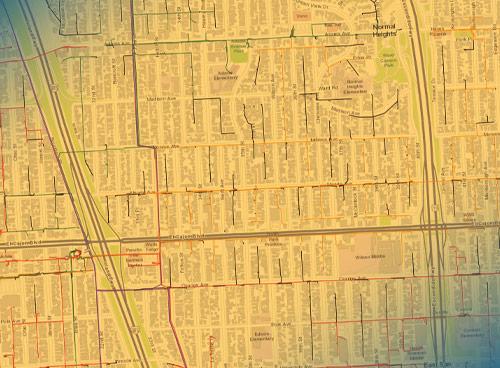
Grid data is often seen as complex and accessible only to industry experts. Yet it plays a critical role in key decisions, from EV charger siting to planning and budgeting for utility upgrades. If grid data is essential to deploying the infrastructure needed to power our nation's growing EV adoption, the question becomes: how do we make this information clear, accessible, and actionable for everyone — from small developers and public agencies to large-scale EV charging providers?
Hosting capacity analysis (HCA) maps serve as a practical tool for bridging this gap. They offer transparent, detailed insights into where the electric grid can support new load — such as EV charging infrastructure — and where costly utility upgrades may be unavoidable. As a result, HCAs are emerging as a critical tool for EV charger deployment.
Yet there is a challenge: HCA maps are not always publicly available nor consistently designed using best practices. With thoughtful regulatory action, however, HCAs can become more accessible, reliable, and user-friendly. In doing so, they can help accelerate EV charger deployment — equipping stakeholders with the information they need to make more informed decisions and more easily navigate utility requirements with greater confidence.
What Is a Hosting Capacity Analysis?
A hosting capacity analysis (HCA) is a data analysis tool developed by utilities that provides information on how much new load and/or generation the grid can currently accommodate at different locations. Load-focused HCAs are particularly relevant for EV charger — or EVSE — deployment, as they evaluate the grid's ability to serve new electrical demand under existing operating conditions.
 Catelyn Sweeney: The publication of HCAs is typically at utilities’ discretion, though state regulators can mandate it. State-mandated HCA publication can help establish a consistent framework that ensures reliable, high-quality grid data is available statewide.
Functioning like a GPS for the power system highway, HCAs display basic utility information — such as substation information, circuit voltage, amount of connected generation, and location of distribution lines — in the form of a map or tabular data files.
See Figure One.
There are two types of HCAs:

Generation HCAs, which estimate where distributed energy resources (DERs) like solar can interconnect without triggering upgrades, have been in use since 2015.
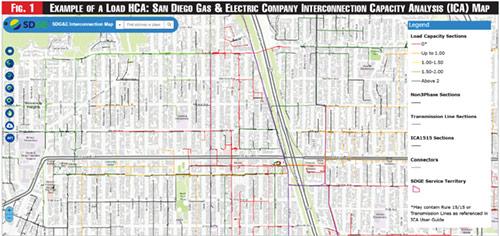 Figure 1 - Example of a Load HCA: San Diego Gas & Electric Company Interconnection Capacity Analysis (ICA) Map
Load HCAs apply the same analytical concept to new large load additions, such as EV charging stations, and are a more recent extension.
While the applications of generation and load HCAs differ, both use similar grid models to assess capacity.
Developing Useful and Reliable HCAs
HCAs are often used internally for planning purposes; however, the expansion of DERs has prompted utilities to make them available to customers. Since 2015, utilities have published HCAs either on a voluntary basis or in compliance with state regulatory mandates. Developed through various processes, publicly available HCAs differ in quality, with certain models offering greater usefulness and reliability than others.
Since 2017, the Interstate Renewable Energy Council (IREC), an independent nonprofit, has advanced the effective use of HCAs and continues to support state adoption of this tool to streamline the siting and utility approval of charging infrastructure and other DERs. Working with state regulators, utilities, and stakeholders, IREC has provided guidance in the development process and applied load HCAs across multiple states, producing a number of lessons learned on what's needed to produce a useful analysis.
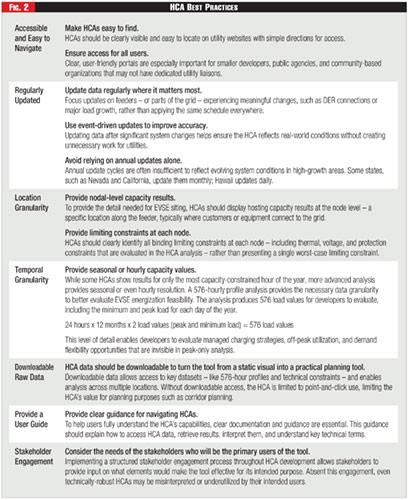 Figure 2 - HCA Best Practices
IREC has identified best practices for developing and designing HCAs that best suit the needs of customers and ultimately support the rapid deployment of DERs, with a more recent focus on load HCAs to advance EVSE deployment.
See Figure Two.
Best Practices: Publishing Load HCAs
With more EVSE projects seeking energization, load HCAs are becoming increasingly essential for predictable timelines, costs, and smoother grid connections. As developers and utilities look for clearer visibility into the system capacity, the public availability of these maps plays an even greater role in early project planning.
The publication of HCAs is typically at utilities' discretion, though state regulators can mandate it. As of November 2025, at least ten utilities provide — or plan to provide — load HCAs. Utility-initiated HCA publications can provide helpful information, but they may not consistently meet best-practice standards for transparency and data quality. State-mandated HCA publication, however, can help establish a consistent framework that ensures reliable, high-quality grid data is available statewide.
As of November 2025, the following states require utilities to publish load HCAs: California, Colorado, Connecticut, District of Columbia, Hawaii, Massachusetts, Michigan, Minnesota, Nevada, New Jersey, and New York. With more states exploring public HCA requirements, it's important for regulators to align their requirements with best practices so the resulting data is both consistent and meaningful.
IREC has recently engaged in California, Colorado, and Nevada to ensure that publicly available HCAs incorporate recognized best practices. These efforts identified gaps in HCA characteristics needed for informing EVSE planning and siting.
In practice, utilities are most willing to adopt HCA features that align with their existing internal planning workflows. When proposed features fall outside of that existing planning scope, reaching consensus becomes significantly more difficult.
As a result, utilities prefer to update HCA maps on the same annual cycle as their internal planning process, even though this cadence may not reflect rapidly changing distribution system conditions on feeders experiencing high levels of new loads, DER interconnections, or infrastructure change.
The grid is evolving fast — driven by the rapid deployment of DERs — requiring HCAs to be updated more frequently and feature more granular data to remain accurate and actionable. Without these, an HCA quickly loses its operational relevance and cannot support timely, data-driven decision making. Consequently, many existing utility HCA maps fall short of IREC's identified best practices.
Unlocking the Potential of HCAs
As more EVSE and DER projects seek to connect to the grid, stakeholders need reliable, high-quality grid data to make informed project siting decisions and to use existing grid capacity more efficiently. HCAs are central to enabling this progress.
Beyond guiding better siting, HCAs bring much-needed transparency to the grid — helping bridge long-standing information gaps among regulators, developers, customers, and utilities. In doing so, they lay the groundwork for a smarter, more efficient, accessible, and clean energy future.
