

Market Mechanisms for LDES Investment
Noah Podolefsky is a Ph.D. physicist, innovator and thought leader with over fifteen years in the battery energy storage systems (BESS) space. As a Senior Advisor with Clarum Advisors, Noah leverages his extensive knowledge of the BESS industry and business strategy assisting funds with investment due diligence, large corporations with BESS innovation, and energy storage startups with growth and commercialization strategy.
Molly Podolefsky is a Ph.D. economist and leader in the energy and sustainability industry with experience spanning decarbonization, the utilities and energy sector, finance and investment and business management. As a Managing Director with Clarum Advisors, she leverages her knowledge and experience working with utilities, startups, corporations and funds in the energy transition space.
The past five years have seen an explosion of innovation in the long duration energy storage (LDES) space in response to the rapid expansion of variable renewable energy generation and the need for ever larger tranches of energy storage to firm capacity while displacing fossil generation.
In Part One of this series in March PUF, we explored the current state of LDES, providing a framework based on the needs of customers to identify the set of technologies best positioned for success in this emerging market — carbon dioxide, flow, iron-air and lithium-ion batteries.
Despite the proliferation of novel technologies, LDES has been slow to gain market traction and is still seen as a relatively high-risk investment. Significant barriers to capital investment in LDES technologies remain, hence the persistence of high-cost curves and lagging commercialization. In Part Two of this series, we consider barriers to investment and explore the set of market mechanisms required for LDES to advance.
Barriers to Investment
LDES vs. Modular Substitutes: Given that an array of short duration batteries and a single LDES system can accomplish the same task within a given period of time, the question becomes at what point LDES is more cost-effective.
For example, to provide backup power for a 50-MW campus for 10 hours, the site could utilize a 10-hour, 500-MWh LDES system, or a set of 125 4-MWh lithium-ion batteries. While LDES technologies are still more expensive than lithium-ion today, the cost curves for both are rapidly evolving. This means the balancing point where LDES solutions become cost-effective is constantly evolving, adding uncertainty for investors.
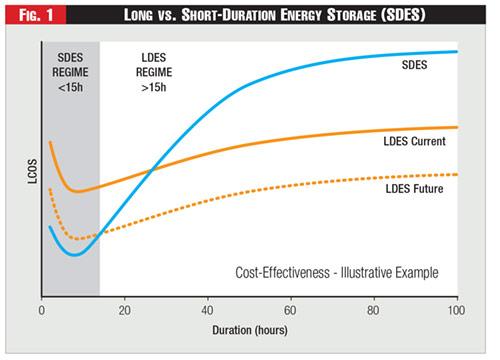 Figure 1 - Long vs. Short-Duration Energy Storage (SDES)
See Figure 1.
Cost Curves and Commercial Readiness: Another significant challenge facing investment in LDES is the relatively high cost of LDES technologies relative to natural gas generation. To displace fossil-based firm generation, LDES must achieve similar costs. In its Long Duration Storage Shot, meant to accelerate decarbonization of the grid, the DOE set the target LCOS for LDES at $0.05/kWh — which would place it on parity with the cost of natural gas generation.
Figure 2, showing the maximum CapEx, by duration, compatible with the target, illustrates how an energy storage resource that is cycled daily can recoup a larger CapEx over the course of a year relative to a technology that is cycled only a handful of times annually.
See Figure 2.
 Noah Podolefsky: Investors face a chicken-or-egg dilemma when considering the likely trajectory of cost curves for specific LDES technologies in the near term. While many LDES companies confidently project reaching critical cost targets in the near future, this will depend largely on the emergence of supportive market mechanisms.
Today, the only LDES technology that achieves this LCOS target is cavern-based compressed air energy storage (CAES). However, as discussed in Part 1 of this series, CAES is highly geographically constrained, ruling it out for widespread adoption.
While demand will drive growth and innovation, lowering costs, none of the four best-fit LDES technologies identified in this series have yet met this benchmark. Both technical feasibility and demand-driven reductions in cost will determine whether these technologies achieve the LCOS needed to displace fossil-based generation.
See Figure 3.

Investors face a chicken-or-egg dilemma when considering the likely trajectory of cost curves for specific LDES technologies in the near term. While many LDES companies confidently project reaching critical cost targets in the near future, this will depend largely on the emergence of supportive market mechanisms.
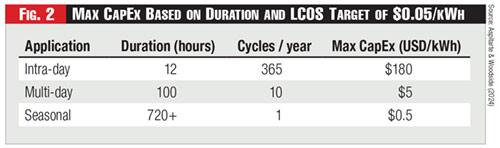 Figure 2 - Max CapEx Based on Duration and LCOS Target of $0.05/kWh
Missing Markets: The most significant barrier to investment is the absence of dedicated markets for LDES products. Today’s wholesale energy markets provide reliable price signals for day-ahead and real-time energy supply, but market mechanisms have not materialized yet in most jurisdictions to set clear, unambiguous, reliable long-term price signals for LDES that will reduce risk for investors and guarantee long-term ROI.
Commercial readiness, cost curve reductions, cost-parity with natural gas generation and the balancing point between modular lithium-ion and LDES all depend critically on the emergence of supporting market mechanisms.
The Need for Market Mechanisms
For LDES technologies to mature and scale, supportive market structures, regulatory frameworks, and policies must be put in place. Mechanisms rewarding contributions to resilience and carbon-emission reductions are needed to strengthen the business case for private capital investment flows into LDES.
Duration-differentiated Capacity Markets: Most wholesale markets today reward capacity contributions to reliability probabilistically, but do not explicitly differentiate between capacity products by duration. Markets must develop explicit duration tiers for 8-hour, 24-hour and multi-day products, sending clear price signals to accelerate the commercialization of LDES.
 Molly Podolefsky: For LDES technologies to mature and scale, supportive market structures, regulatory frameworks, and policies must be put in place. Mechanisms rewarding contributions to resilience and carbon-emission reductions are needed to strengthen the business case for private capital investment flows into LDES.
Multi-day Reliability Products: Most capacity markets currently model reliability products assuming single-day peaks, whereas increasingly frequent and disruptive weather events drive multi-day outages. To effectively compensate and provide reliable ROI for LDES, markets must develop rules and mechanisms for forward procurement of multi-day long duration seasonal resiliency products.
Resource Adequacy and Long-term Contracting: Current approaches to resource adequacy planning and procurement requirements often do not account for sequential, multi-day charging needs, and long-term contracting structures backed by regulatory requirements are often absent.
Given the longer window for LDES investment capital recovery, it will be important to employ large-scale, long-term reliability RFPs for LDES, and to reform resource adequacy requirements to ensure the availability of LDES during periods of multi-day renewable shortages.
Clean Firm Capacity or Reliability Credits: Today, markets for energy, capacity, and ancillary services often do not explicitly reward contributions for lower carbon emissions. To differentiate between clean dispatchable LDES and fossil dispatchable capacity value, markets must develop separate credits paying a premium for zero or low-carbon firm dispatchable power capable of sustained delivery.
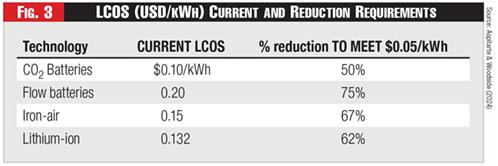 Figure 3 - LCOS (USD/kWh) Current and Reduction Requirements
First-of-a-Kind Mechanisms: Driven primarily by the growth of AI, data center workloads are projected to nearly triple by 2030 relative to 2025 levels. Against this backdrop, hyperscalers and utilities are collaborating to accelerate development of first-of-a-kind (FOAK) technologies, including LDES, to firm clean generation. Within this context, novel financing mechanisms are needed to commercialize and deploy FOAK technologies while shielding existing utility customers from associated costs.
Federal and State Incentives: Federal and state incentives play a significant role in supporting fledgling energy transition technologies, bolstering emerging technologies in the short run, bringing down cost curves and spurring adoption. Federal tax incentives, grants, demonstration funding, loans, and credit programs, procurement mandates and other financial support can accelerate LDES development.
Market Mechanism Emergence
While many of the market mechanisms needed to mature the LDES industry are not yet in place, state, regional, and industry efforts are gaining traction. The following examples highlight the emergence of successful mechanisms across the U.S.
Evolving ISO/RTO Mechanisms: Several system operators and wholesale markets are evolving mechanisms to pay for reliability contributions better aligned with LDES. ISO New England is moving toward a probabilistic accreditation process which assigns capacity credit based on resources’ contributions to incremental capacity during Marginal Reliability Impact (MRI) hours — those with the highest reliability risk — providing a pathway for 10+ hour or multi-day LDES systems to receive higher accredited capacity as reliability risks evolve.
PJM’s Effective Load Carrying Capability (ELCC) framework and MISO’s Direct Loss of Load (DLOL) accreditation method similarly reward capacity during hours with high reliability risk, paving the way for more duration-sensitive capacity valuation in the future.
Emerging Resource Adequacy Requirements: The California Public Utilities Commission provides the clearest example to date of a formal, duration-defined LDES procurement requirement, mandating 1,000 MW of LDES capable of sustaining maximum capacity for a minimum of 8 hours, and disqualifying derated short duration products.
While New York’s statewide energy storage framework focuses primarily on 4- to 8-hour systems, it includes innovation and demonstration support for 10+ hour LDES technologies and considers the future role of multi-day storage.
Massachusetts offers another path forward, through statute-backed, competitive solicitations for mid-duration energy storage systems, under the Department of Energy Resources (DOER) Section 83E. Serving as a bridge market for 6–10+ hour resources, this procurement channel moves beyond historical 4-hour storage solicitations.
Data Center-Driven Mechanisms: Given the rapid expansion and aggressive decarbonization goals of many hyperscalers, LDES will play a significant role firming on-site, low-carbon generation supporting associated load growth. New market mechanisms are emerging to protect existing customers from subsidizing the energy costs of data centers.
As an example, Form Energy’s 30-GWh iron-air battery plant under construction in partnership with Xcel Energy and Google, will leverage a new market mechanism — the Clean Energy Accelerator Charge — to ensure the cost of developing FOAK technologies are not born by other customers.
Advancements in regulatory policy, frameworks and mechanisms around the U.S. suggest that while formal markets with stronger price signals and longer-term contracting will help incentivize LDES investment and commercialization over the next three to four years, the trajectory and pace of market development will vary widely by state, region, and system operator.
In the near-term, investors, startups and corporations should monitor actions by hyperscalers, leading states and system operators, where the earliest and strongest markets for LDES are likely to take hold, setting a path for others to follow.
