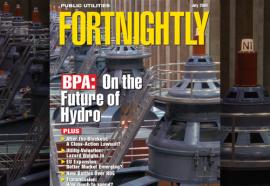
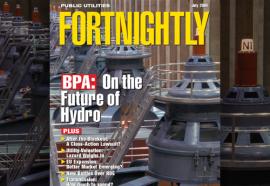
ISO

Facing the Death Penalty

Did FERC's market power ruling go too far?

Market-based sales put at risk are the financial lifeblood of some utilities, especially those of the multi-billion-dollar, vertically integrated variety. Those that fail FERC's market-power test will be forced to sell their excess generation at cost-based rates — a "death penalty," according to some utility CEOs.


The Devil in the Transmission Data

Untapped T&D measurement data could make the difference on reliability.

As transmission operators are forced to deal with increasingly less comfortable margins of reliability, choices must be made about acceptable levels of risk. Essential to such determinations is the analysis of untapped operational and non-operational data.

Western Power Markets: Ready for A Wild Ride

IOUs take action, but other overriding forces will affect prices in the near term.

The new capacity brought on line in 2003 and 2004 likely will not drive down market prices but may well provide a measure of reliability to the market, possibly counteracting some of the usual price volatility seen in low hydro years. This is good news for the wholesale power business, and it signals that the industry is beginning to claw its way back from the near-death experience of the past few years.

Letters To The Editor

ISO/RTO

I believe the primary measure of successful “deregulation” is a minimization of the delivered cost of power to end users, at an acceptable level of reliability. To help achieve that, I suggest the following actions should be taken nationwide on a timely and consistent basis.

People

People for July 2004.

Positions filled at American Electric Power, Schneider Electric, Foster Wheeler Energy Limited, and others.

Lost in Translation

Critics say FERC's filed rate doctrine is wrong for the times.

It’s quite remarkable how the Federal Energy Regulatory Commission (FERC) has been able to pound a square peg into a round hole. With not much more than a wink and a smile, FERC has taken a depression-era law meant for monopolies — the Federal Power Act — and has made it serve double duty as a foundation for competitive power markets. Yet FERC’s reinterpretation, for all its good intentions, may prove inadequate in the long run to define and support full-fledged energy markets.

Consolidating Co-ops

Like it or not, changes are coming for electric cooperatives. Fewer and bigger might be the inevitable result.

Most electric co-ops remain small, local entities. But that historic strength may be keeping them from fulfilling their primary mission—to provide reliable electricity for the lowest possible cost.

The New CEOs

Whether utility leaders come from law, engineering, or finance, one thing can be said: Many of the new CEOs have had diverse experiences.

Our annual CEO survey looks at six new utility leaders: Mike Morris of AEP, Robert McGehee of Progress Energy, Michael Chesser of Great Plains Energy, Gary Rainwater of Ameren Corp., Dennis Wraase of PEPCO, and Paul Anderson of Duke Energy.

A Rough-Cut Diamond: Fortnightly Turns 75

Let's look back over the past few years — what we got right and where we went wrong.

So we come to the 75th anniversary of the publication of Public Utilities Fortnightly. Few magazines ever live that long. Nor should they. Yet here we stand. Launched in 1929. Still kicking in 2004. We can learn from the experience of the past 10 years — a time of turmoil like no other in the utility industry. So let’s lean back and have a little fun. What can we learn from Public Utilities Fortnightly over the past decade?