

Niagara Power Project
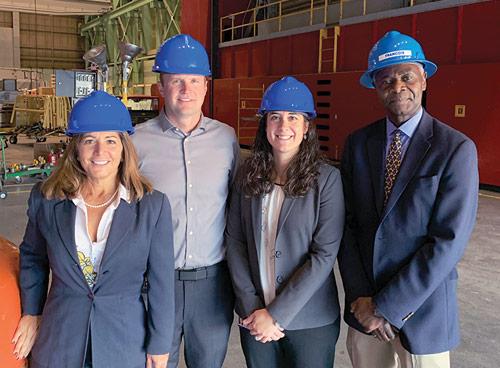
New York Power Authority’s Niagara Power Project VP for Project Management Patricia Lombardi, Regional Manager Harry François, Senior Program Director for Generation, Andrea Luongo, Ops Superintendent Chris Carey, Project Engineer Brad Otto, VP Corporate Communications Ethan Riegelhaupt, and Director for Community Relations Lou Paonessa.
Glorious fall weather greeted PUF's editor-in-chief and managing editor at the end of October when we arrived at New York Power Authority's Niagara Power Project to take in NYPA's huge refurbishment investment. The 1.1-billion-dollar hydroelectric plant upgrade will take place over fifteen years and we took a deep dive into what is called Next Generation Niagara.
We visited NYPA's Niagara Power Vista Visitor Center and learned the history of the prior Schoellkopf Power Station, a mighty hydroelectric plant that collapsed into the Niagara River in 1956 and led to the opportunity for NYPA to build the Niagara Power Project. The resulting Robert Moses Niagara Power Plant built in 1961 is the centerpiece of the upgrade.
We stayed in the picturesque town of Lewiston, the namesake of the Lewiston Pump Generating Plant, a hydroelectric facility that works with the Robert Moses plant. We were accompanied in the depths of both facilities by Christopher Carey, an engineer and operations superintendent who seems to know all.
Come along as we take you on our journey with the people leading the way on this incredible Next Generation Niagara project. It is fascinating.
Patricia Lombardi, VP Project Management, and Andrea Luongo, Senior Program Director Generation
PUF's Steve Mitnick: Patricia, you're responsible for projects throughout NYPA and New York state. Tell us what you do.
Patricia Lombardi: Sure. I'm fortunate to lead a team of project managers, construction managers, project and construction staff, and our team is responsible for executing the large capital programs mainly on the utility operation side of the house for NYPA. This covers large capital and some larger operations and maintenance investments at our generation and transmission facilities.
We're fortunate to get involved in quite a lot of the diverse work that NYPA does. That's what makes the job fun and rewarding. It's challenging, but fun.
PUF: What's a typical day like for you?
Patricia Lombardi: Every day is a little different. Today I'm at Niagara. Last Friday I was at Niagara. Thursday I was in Astoria. Wednesday I was at Clark. There's a bit of travel involved. Whether it's to see projects, meet with senior leaders, or meet with my teams, it can be quite different. But typically, I'm based out of White Plains, so there's no shortage of meetings every day.
 Andrea Luongo: Lewiston Pump Generating Plant is a pump generating station. It helps manage the water levels for the Robert Moses Power Plant. It has a unique ability, as it can be run in reverse, it can pump, or it can generate on its own.
PUF: How do you like being on the road?
Patricia Lombardi: That's the fun part of the job, just getting out there. I came up through the company as a project engineer, so I miss being out in the field.
PUF: What led to your being chosen as vice president?
Patricia Lombardi: Out of college, I worked for a construction company in New York City for about a year or so, and then I started with NYPA as an assistant engineer at an entry level role and then worked up through the ranks, became a project manager, and took this position in 2016.
PUF: Andrea you work with Patricia. What's your job?
Andrea Luongo: My job is working closely under Patricia to make sure all the capital and operations and maintenance projects assigned to my region are implemented and aligned with our strategic initiatives, budgets, and schedule.
We recently were certified in ISO 55001, which means that we are meeting international standard for managing our assets. It was a monumental effort across the organization. The whole premise behind the ISO 55001, is making sure we're executing the work in alignment with NYPA's strategic asset management initiative.
Every project that comes into the portfolio has value or adds value to the organization. It aligns with making sure our assets are functioning at peak efficiency, are operationally reliable, and maintenance and upkeep costs are minimized.
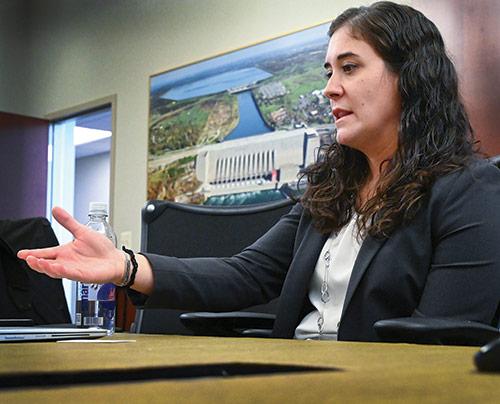 Patricia Lombardi: With Next Generation Niagara, we’re talking about a fifteen-year project.
PUF: You focus more on generation as opposed to transmission?
Andrea Luongo: Yes, I do. If we don't make the power, it can't be transmitted and if transmission isn't there, we can't do anything with the power. Next Generation Niagara is one of the largest generation projects that the state is undertaking, as well as New York Power Authority.
We are almost eighty percent complete with another large generation project. The Lewiston Pump Generating Plant, which is part of the Niagara Power Project is undergoing a life extension and monitorization. To Patricia's credit, that was one of the first major programs that she kicked off for the New York Power Authority.
PUF: What does that do? Lewiston is another huge hydro project?
Andrea Luongo: Lewiston Pump Generating Plant is a pump generating station. It helps manage the water levels for the Robert Moses Power Plant. It has a unique ability, as it can be run in reverse, it can pump, or it can generate on its own. So, it's one of Niagara's other finest assets next to Robert Moses.
PUF: What's a typical day like for you?
Andrea Luongo: What I love about my position is every day is different. I currently have a team of eight individuals that work alongside with me - they're the work horses.
They handle the day-to-day activities that make a construction project move forward. It's their responsibility to handle stakeholder management and communication that push the work along through the various phases of the project lifecycle. What I'm doing is constantly supporting them, checking in, and making sure that any issues that arise are resolved.
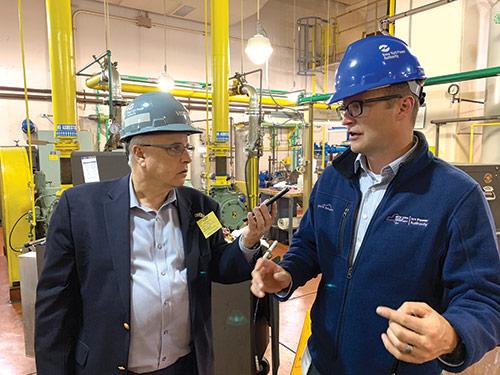 PUF editor-in-chief Steve Mitnick interviews Christopher Carey on governors and compressors at Lewiston Pump Generating Plant.
Almost every day scenarios arise that require escalation and resolution. There's a tremendous number of stakeholders that are involved in each job. When I say a stakeholder, we have engineering counterparts, all the disciplines, mechanical, electrical, protection and control, environmental, health and safety, licensing, marketing, NYPA management, and the customer side, all different stakeholders on every project.
Sometimes it can be overwhelming to the project engineers who work on the day-to-day construction aspects and they need my support to go and navigate some of the other issues. One of the big responsibilities in my current role is looking forward - not just at what's twelve months in front of us, or even three years in front of us. In project planning, that's the low hanging fruit.
Years fly by almost as quickly as twenty-four hours do in a day. We want a good vision of where we need to be and how we're getting there for the five-year, or ten-year look-ahead. That's the big driver behind my current role. It's easy to throw people at the work and say hire new people, we need new or more resources.
One of the things Governor Cuomo and the state is passionate about, is making sure they take care of the people that are taking care of the projects that in turn benefit the state. In doing so, you have to be strategic in how you onboard new people.
If you have the work in front of you for the next zero to twenty-four months, what happens after twenty-four months? Do you still have the work to support those positions? So NYPA has been key over the past decade in getting more strategic and looking at the bottom line of what's going to give the most return to the public, but at the same time protect its people and its assets.
PUF: Do you ever work with Patricia?
Andrea Luongo: She checks in at regular interval to see how things are going. My typical response is, I'm living the dream. I say what I mean.
PUF: You have a team. Do you all ever get together and say, whoa, we've got a lot going on here. How does that work?
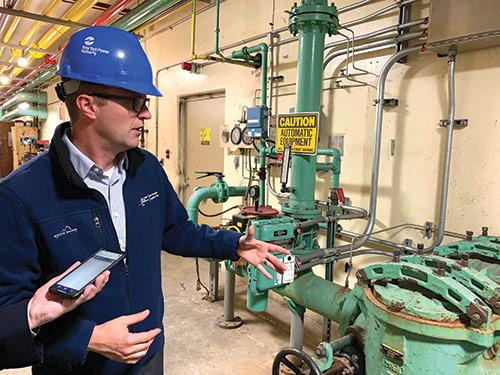 Christopher Carey explains use of cooling water inside Lewiston Pump Generating Plant.
Patricia Lombardi: Yes, all the time. One of the best parts for me is that everyone is different. Everybody's got a different personality. They each have a different style, which makes it challenging and fun for me as well.
They all vie for who's the favorite child in the group. But we're all based out of White Plains for the most part. I do have one direct report that commutes back and forth from St. Lawrence. But we're all close. We have an open relationship.
What is good is that they challenge me. That's in the appropriate way and a respectful way, which I appreciate. They try to keep me calm when I get fired up. Like this is okay, this you need to worry about, this I got.
It's always helpful as a leader to know, and to know that they'll come to you when something is real and they need help or sometimes it's just, hey keep your eye on this, but I got it. That's the good part of the relationship.
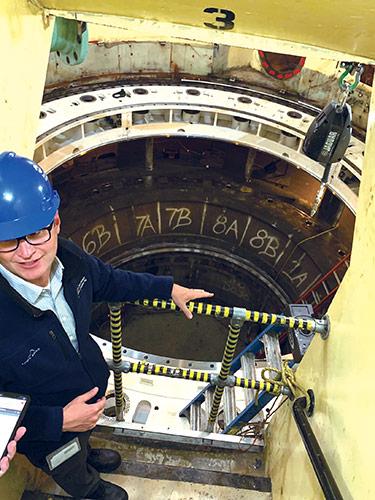 A disassembled turbine unit.
PUF: Andrea, what did you do before?
Andrea Luongo: I came from another state agency. I was fortunate to work at Battery Park City Authority. When Governor Rockefeller had the idea of building a residential neighborhood in the heart of downtown New York City, he formed Battery Park City Authority. I did the first ten years of my state service down in New York City developing and building out Battery Park City.
PUF: How did you end up here?
Andrea Luongo: The former CEO of Battery Park City went on to serve as a CEO of the New York Power Authority. He had reconnected with me at a holiday party at Battery Park City. He jokingly said to me, when are you going to come work for me? I said, when you have a job that suits my skillset. Sure enough, they had postings and he flipped them to me. I applied and the rest is history.
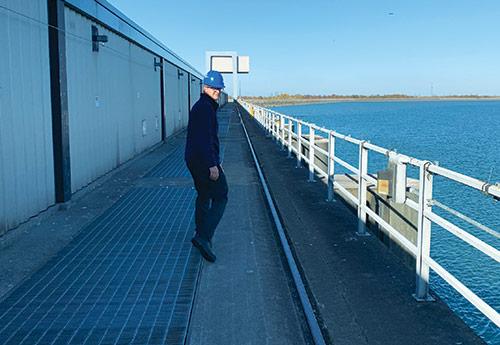 The tour took us to atop the roof of Lewiston Pump Generating Plant.
PUF: Patricia, what's the most fun about your job?
Patricia Lombardi: Two things. One is definitely the diverse work. So, I came up, like I said, as a project engineer. We did parks, we've built boats, we moved chimneys, we do work at hydro, we do work at fossil, we do transmission. Every job, even if it's a circuit breaker here and a breaker there, they're different. They're always different.
That's definitely the rewarding part of the job. It's not just rinse and repeat. Number two is the people. I have a good team. Then I get to work with fine people like Chris [Carey, operations superintendent].
I'm not just saying it because he's here, but we do have a good relationship. We can challenge each other and be open. In the roles we have, we get to see a big cross-section of stakeholders.
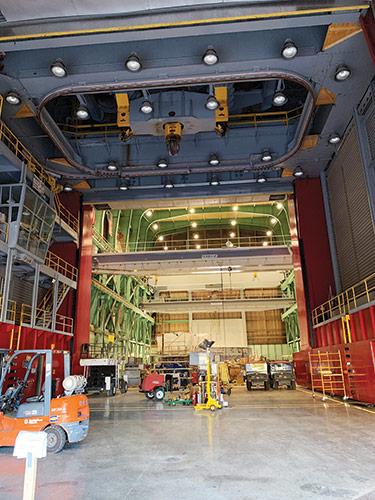 The ginormous 630-ton crane to lift the heavy components for maintenance projects at the Robert Moses hydroelectric plant.
We work with every single department at NYPA, risk, legal, engineering, communications, you name the department, we probably work with them. For me and my people on the team, we get a diverse experience working in the organization. That's how you grow, get exposure, network, and it's one of the best parts of the job.
PUF: Andrea, what's the most fun aspect about your job, if any?
Andrea Luongo: Oh, there's plenty. If things are not fun or challenging for me, I don't feel I can be at my best. I have a pretty good track record - I rarely take a sick day; I always have leftover vacation and it's because I love what I do.
The challenges every day, the people, and the encouragement of this organization to be innovative and forward thinking. That's what's keeps it interesting, fresh, and the years seem to pass like months. Even though things are similar, there's a new challenge each day and it just keeps you sharp.
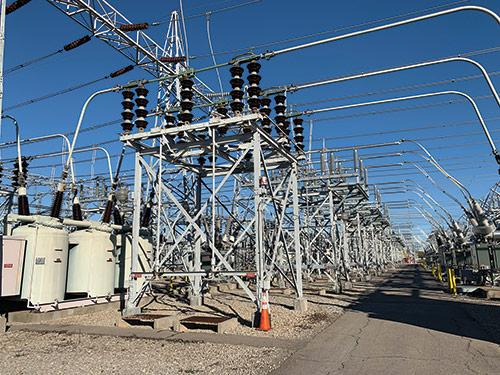 NYPA’s massive switchyard at Niagara.
You asked me earlier, what does a senior director of generation do? Well now it's up to me to help guide the people that are on my team in learning how to make decisions, learning what are the key boxes to check and answer, so that they can come up and put their style and their knowledge into generating new solutions. There is no one size fits all - not one answer to every question and it's up to me to be able to help the team develop by asking questions that'll lead them toward an answer or challenge their thinking to solve a problem.
It is amazing work. I mean, with the infrastructure we're building and the power assets we're maintaining, we're part of New York history.
Patricia Lombardi: Yes. I don't think there's anything more rewarding than seeing a drawing and then seeing it built.
Andrea Luongo: Indeed, tangible results.
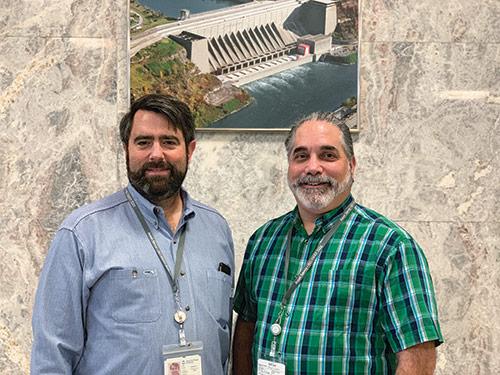 Brad Otto, project engineer, at left, and Angel Rivera, mechanical maintenance superintendent.
PUF: Patricia, things don't always go smoothly. What kind of challenges crop up and then what do you do?
Patricia Lombardi: There's a couple of things that you want to remember. This is a dangerous industry. There is always the risk of injury or even fatality.
It's understanding that you're in a dangerous business. It's understanding that safety is always first and foremost. When things don't go right, and sometimes they don't, I think two things. You hope that the people who are working for you and with you, that you've helped them along the way to know how to react.
It's about having a relationship where you can be open and honest about what happened. You don't want people hiding things or covering things because they don't feel comfortable.
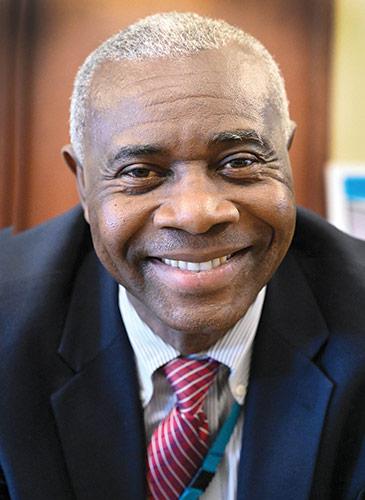 Harry François: There are a lot of talented students from SUNY Buffalo, and we have our own apprentice training program so employees can come through the rank and file.
Be able to admit that something went wrong. Take accountability. I don't think anybody in this room has never made a mistake. It happens and that's how you grow and learn. I can say I've learned the hard way, on many occasions, and it just makes you better.
But you have to remember, especially when leading people, that accountability is important. It's saying, we're not going to punish you, but you've got to own up to it.
Then it's knowing how to react, especially when it could be a stressful situation that needs a smart and quick decision. Did we give people the right tools to make those quick decisions in that moment without having to check with me or check with Andrea? Can they make a good decision when it's important?
PUF: Andrea, how do you deal with that?
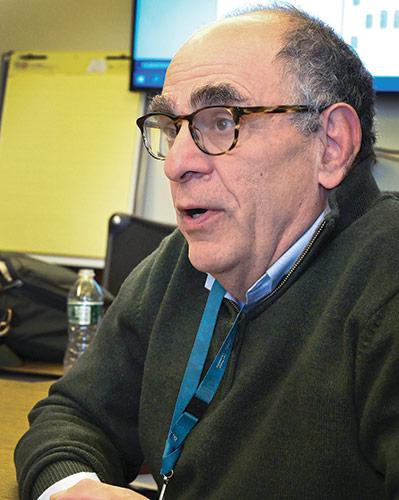 Ethan Riegelhaupt: Preparing the Niagara facility for the challenge of the next half century is essential. As a major supplier of electricity to New York State, it is an important contributor to Governor Andrew Cuomo’s Clean Energy Program.
Andrea Luongo: I am a person who embraces challenge and we are lucky that this organization encourages innovation and that comes right from the top with Gil Quinones our president and CEO. I look at the challenges and the not so good days as, all right, bring it! Business as usual is not for me.
Patricia Lombardi: I can vouch for that. She just said it last night when I said I have something for you.
Andrea Luongo: Patricia and I were missing each other through the recent frequent travel and so we didn't get to connect for a few days and there was a situation and she wanted to be sure I was aware of it. Over the phone, she brought up what was going on, explained certain things, that I've probably seen over a dozen times. She stressed she wanted me to handle it. I'm like, is that it? Well, give me more, I can do more than that.
Patricia Lombardi: But then she quickly said, well wait a minute.
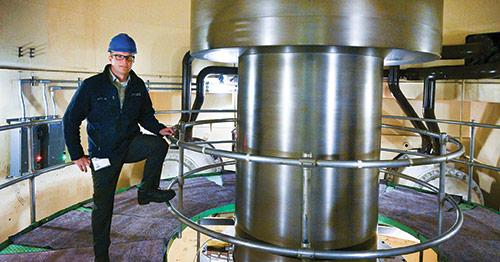 The hydro plant has huge rotary equipment.
Andrea Luongo: Yes, I did backpedal. There is a lot going on right now with Next Generation Niagara, the Lewiston Pump Generation Plant Life Extension and Modernization, the Communications Backbone project, as well as onboarding new people and end of year vacations.
But each of the challenges are what builds and develops me, and the team and engineers are trained to solve problems. So as much as we don't want problems every day, know that when you enter any project, when you enter any situation in life, something will always go wrong or not as planned.
Have a plan and stick to the plan. Knowing that something will go wrong should be part of that plan, and how you'll respond to anything that's thrown at you. This is a good exercise in mapping and managing the risks for a project. Sometimes things just won't go as planned and it is a little more challenging. You just embrace it as an opportunity, develop, and get better from that opportunity.
PUF: Patricia, if you can look out two or three years from now, what do you think you'll be doing? What will we be talking about?
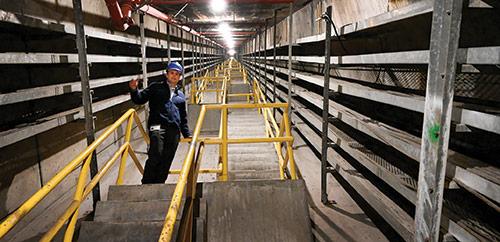 A stairway to heaven some four hundred feet to the top.
Patricia Lombardi: I'd like to say I'm still in this role. There's plenty of work left to do. It's hard to say what's going to happen in three years. I mean, three years ago I wasn't here. Things change quickly at NYPA.
If you asked me the question three years ago, I would not have told you I would be here. So, probably, whatever I tell you today won't be right where I am in three years. But in the context of this, I love what I do.
There's no shortage of rewarding moments. Like Andrea, as long as I'm passionate about it, I love it, I'll do it as long as they let me stay here and we're successful at it. Otherwise, there's a lot, NYPA's investing in quite a lot. It's quite a diverse organization. So, there are definitely opportunities, but I'll stay here as long as I can.
PUF: These projects don't get done in a week or two.
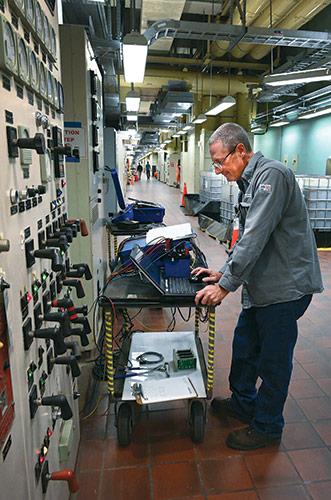 The Robert Moses hydroelectric plant is really big inside too.
Patricia Lombardi: No, they don't. With Next Generation Niagara, we're talking about a fifteen-year project. That's just one of what are probably several hundred projects we have in the portfolio. There are years, decades, worth of work left to do of projects we're planning today and that doesn't even account for whatever's to come tomorrow and next year.
PUF: On this Niagara project, where do you think you'll be in three years? It's a fifteen-year project. Will you be able to complete it on time?
Patricia Lombardi: Andrea has laid out the schedule, so we will be right on schedule.
PUF: Will we be able to see some tangible results?
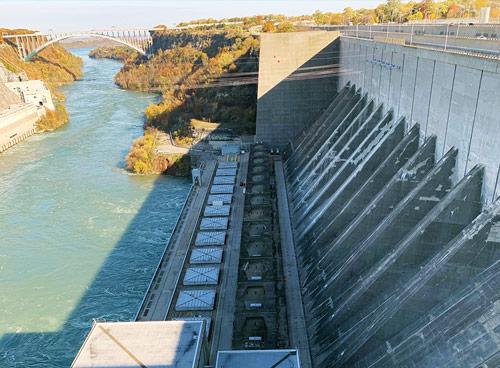 Overhead view of the massive Robert Moses hydroelectric plant.
Patricia Lombardi: Yes, 2023 will be an exciting time. We'll have some controls work done; we'll be tearing apart a machine. In 2023 there'll be some tangible things to talk about at that time and see some good success stories. It may not all go right along the way, but it will be a different world in 2023.
PUF: Andrea, where we going to be in three years?
Andrea Luongo: In three years, the first unit control will be completed - what that means is digitizing our first unit will be completed along with navigating through everything that likely will present as challenges on the first one.
As Patricia says, and as I said earlier, something will always go wrong and that's okay. You just have to have your mitigation strategy for how you will recover from that.
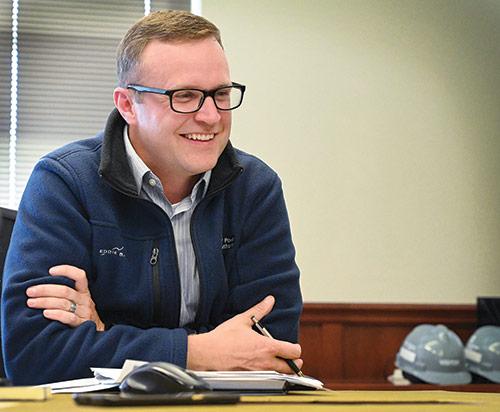 Chris Carey: Our facility is like three in one. We have our Robert Moses plant, more of a traditional run of the river plant, is 13, 225-MW units. Our Lewiston plant, a traditional pump storage plant is 12, 25-MW units. Our switchyard, right under 90 breakers is 21 transmission lines with 5 auto transformers.
We will have navigated through a twelve-month monitoring period where we're learning what went right and what maybe didn't go so right. We will use that to digitize the second unit and so on. We will have the infrastructure and skeleton of the backup control room built out.
Only two units will be fed into the backup control room at that time. Because that's the sequence. The current main control room will also be upgraded to function in a similar way to modern-day control rooms with all the monitoring boards and visual screens that are the latest proven technologies.
I notice behind us, we have a Next Generation picture board here. So, that's what you will start seeing in the backup control room, and at the same time the control room you had the opportunity to see yesterday, will undergo similar improvements.
You definitely will be seeing tangible accomplishments in three years. In March of 2023 we start the first mechanical electrical disassembly and reassembly for upgrading the units. So, quite a bit will happen in three years.
Harry François, Regional Manager, Western NY, Chris Carey, Operations Superintendent, Brad Otto, Project Engineer II, Ethan Riegelhaupt, VP Corporate Communications, Lou Paonessa, Director for Community Relations
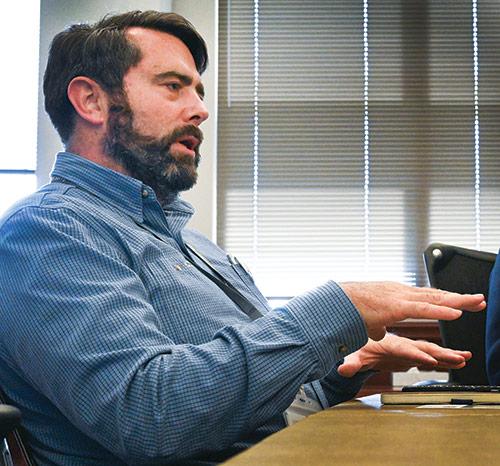 Brad Otto: Next Generation Niagara is about digitizing the Niagara Power Plant and replacing equipment that is at the end of its useful life. A lot of the equipment is 60 years old and has never been replaced.
PUF: Harry, what do you do here at NYPA?
Harry François: I'm the Regional Manager of Western New York. I am responsible for the operation of the Niagara Power Plant, which includes the Robert Moses Power Plant and the Lewiston Pump Generating Plant and the Switchyard Substation. My goal is to make sure that we produce the amount of electricity daily and seasonally that is needed to meet our customer demands.
I am also responsible for making sure that our power is generated under safe and environmentally responsible conditions, that we communicate and engage with the required governmental agencies involved in our operations, that we operate within our budget, and that our personnel perform the required work to maintain the structure of the plant.
PUF: This Niagara facility is just part of it. You have some other projects all over the State.
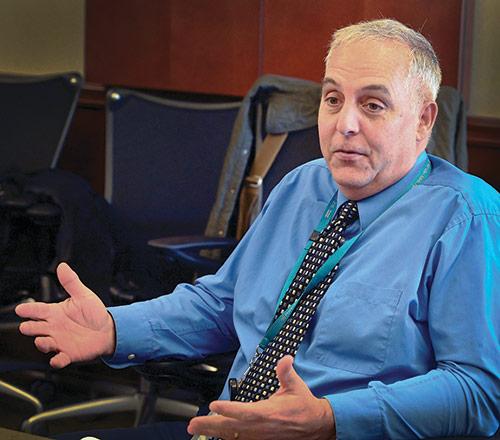 Lou Paonessa: We are the major source of low-cost power that is tied to business and industry. Also, there are 30,000 jobs that exist in Western New York simply because the Niagara Power Project provides that low cost power.
Harry François: Yes. The Power Authority has assets all across the state. I'm responsible for the Western region and there are other Regional Managers responsible for Central New York, Northern New York, South Eastern New York, and Transmission.
PUF: We have a couple of your friends here that work with you.

Harry François: Yes. I have five Superintendents reporting to me. With us today is the Operations Superintendent, Chris Carey. In my absence, Chris oversees the plant.
PUF: Chris, what do you do here?
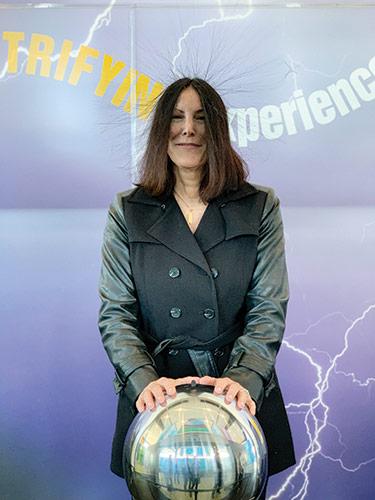 PUF managing editor Lori Burkhart trying out the Van de Graaff generator at the very cool visitor’s facility.
Chris Carey: The big thing is just trying to, similar to what Harry said, ensure the reliability of the plant as a whole. We're making sure that water is going in one direction and power is going in the other direction. We're trying to ensure that when power is needed, that we're able to supply our customers with low-cost, clean, and reliable power.
It's making sure that our customers are getting the best deal out there and keeping safety and reliability number one.
PUF: You've got hundreds of people at the plants, the pump storage facility, the river, and massive dams all the time. They're doing maintenance projects. You're making the project digital, and you're producing megawatts of power, so what's that about?
Chris Carey: Yes. Our facility is like three facilities in one. We have our Robert Moses Power Plant, which can be looked at as more of a traditional run of the river plant. It is thirteen, two hundred and twenty-five megawatt units. Then we have our Lewiston pump plant, which is a traditional pump storage plant. We have twelve units there. Each one is about twenty-five megawatts. Then we have our switchyard, which is right under ninety breakers and twenty-one transmission lines with five auto transformers.
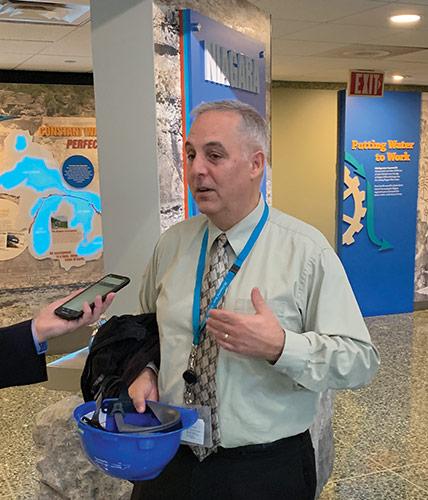 Lou Paonessa: We wanted to give the Niagara Falls community another tourist attraction, and a reason for people to stay longer and learn about hydropower.
PUF: All this is connected. Then you have to deal with the Canadians when it goes through one facility and goes through the other. It's like three-dimensional chess.
Chris Carey: It is. It's a big balancing act. It's like you have three legs on a stool and you're making sure that all legs are solidly grounded and are all in place at one time. Because if one leg has a problem, the stool, as a whole, is going to be affected.
Regulation is provided by generators that are willing and capable of responding to changes in the system load, by almost instantaneous changes. For us, this happens every six seconds, and is known as our base point. At Niagara, we have the ability to adjust our load by hundreds of megawatts within a few minutes. As the load request or base point of the Niagara Project changes, that directly relates to turning units on or off at a moment's notice. In these load change situations, another huge component is managing our water. It's all just one big three-dimensional chess, like your analogy.
PUF: You're balancing New York ISO and sometimes did you say a lot of the Northeast?
Chris Carey: At times if there are certain commitments from say the international ties or from out of state interconnections that are misbalanced, we can account for that and we can essentially regulate outside of our state.
PUF: Now Brad, you're on the new engineering side. But you work with Chris, hand in glove. He's trying to make things go every day. But your work is for the future. What do you do?
Brad Otto: I'm working in Project Management and helping to manage Next Generation Niagara.
Next Generation Niagara is about digitizing the Niagara Power Plant and replacing equipment that is at the end of its useful life. A lot of the equipment is sixty years old and has never been replaced.
It's time to replace it and do it now before something breaks and we have an equipment failure. So, it's two-phase. The first is digitization, which makes the plant more flexible and easier to run, both in the short term and the long term. We've got equipment out there that you can't replace anymore. We're going to replace that equipment with a modern piece of equipment that is easier to replace, and easier to maintain.
We're going to try to consolidate some of his equipment into a single computer system, so instead of having seven or eight different computer systems he's got to work between and around, he'll have one computer system that runs everything.
Then the second part is replacing equipment that's starting to wear out. We want to replace that on a normal schedule, so we can make sure that the outages are taken with the rest of the plant maintenance in mind, the rest of the upgrades in mind, and any distribution transmission line outages that may be taken.
We have to work in all those concerns to make sure that our work doesn't affect the rest of the system and it doesn't affect the rest of the operation of the plant. If we turn the power off for the whole state, everyone would be very upset.
PUF: Ethan, you're a vice president from the headquarters of White Plains. Why is this Next Generation Niagara such a big deal?
Ethan Riegelhaupt: This is important because it is one of the most significant energy infrastructure projects in the state at this point. The hydroelectric plant was originally built back in the late 1950s and early 1960s, and now we are making a commitment to extend the life of this plant for another fifty years. Preparing the Niagara facility for the challenge of the next half century is essential. As a major supplier of electricity to New York State, it is an important contributor to Governor Andrew Cuomo's Clean Energy Program.
Chris Carey: That isn't often spoken about, but it is one of the critical components if we're to achieve the governor's ambitious vision for the mid twenty-first century.
PUF: Harry, this isn't an easy project.
Harry François: Well no, not at all. There are always challenges because again, when you look at the Robert Moses Power Plant, which Chris mentioned, it's the jewel of the Power Authority, the largest hydropower project in New York State and we generate two thousand six hundred and seventy-five megawatts in the plant.
People in the state rely on the plant, which is a huge challenge. We've got to make sure the life extension modernization that we're going to be doing here - Next Generation Niagara - is done effectively, is done economically, and that it improves the reliability of the plant.
We will be putting in new equipment that is digitized and we have to make sure that whatever new equipment we put in will not make us vulnerable to cyberattacks. We have to be prepared and we have to make sure that we are operating at the optimum level for the people of New York State. These issues play a huge part in what we will be doing here. It's going to be huge.
Also, the work involved in Next Generation Niagara will be creating a lot of jobs. This is going to be a fifteen-year project and it will help the economy.
PUF: Lou, talk about the impact of this project when it first got started in the '50s.
Lou Paonessa: The genesis of the Niagara Power Project occurred back in 1956 when a private power producer, the Schoellkopf power plant, collapsed into the Niagara river gorge. It created an instant energy crisis in Western New York.
PUF: It was a private company?
Lou Paonessa: Yes. All the manufacturers who depended on the power from that plant were all of a sudden in a power crisis. So, that created the New York Power Authority's opportunity through federal legislation, and state government legislation to build the Niagara Power Project, which was an outstanding and incredible engineering accomplishment. It was constructed in three years, with the first power generated in 1961 to solve that energy crisis.
Just as we were so important to the business and industries back then, we have been over the course of fifty-seven years since. We are the major source of low-cost power that is tied to business and industry. Also, there are thirty thousand jobs that exist here in Western New York simply because the Niagara Power Project provides that low cost power.
PUF: Why is it low-cost power?
Lou Paonessa: We have an advantage. We're using the limitless supply of water from the great lakes as our fuel source. The water we use comes in at the same volume, and is the same temperature coming in as going out. We don't destroy the natural resource. We have a built-in advantage of free fuel as opposed to burning a dirty fossil fuel, coal, buying natural gas, or buying oil. We don't have that fuel cost. We have a built in, abundant, free, clean, green energy source.
PUF: That's one of the reasons or that's a major reason why there's a fairly vibrant and diverse economy in this area.
Lou Paonessa: People have come to Western New York because they saw the immense power of the falls and they saw that the low-cost power could be provided because of that. It gave them a competitive advantage in their business in that industry. That covers everything from chemical plants along our industrial corridor to manufacturers to now even data centers, which are power intensive users. The low-cost energy and abundance of energy we can provide is the reason why they locate in Western New York.
SUNY Buffalo is one of our major users of many NYPA services and we help them lower their energy usage and their energy demand through the services we offer. Next Generation Niagara is also a part of our digitization of NYPA. So now we can tell people how to better use their energy, lower their energy demand, and lower their costs. For municipalities and our muni customers, they can pass lower taxation rates and energy costs to their customers, due to the lower cost power and less power demand.
We have a wide-ranging impact on the community. We'll provide billions of dollars-worth of ecological and recreational benefits to our region over the course of our operating license. Next Generation Niagara makes all that possible as it keeps the plant viable into the future. All that impacts Western New York.
PUF: Chris, you've got to keep these facilities humming, and there's water, so sometimes there is ice, and there are storms. You have cybersecurity. Tell me some of the challenges.
Chris Carey: It's interesting, when you step back at times and you think about it because as long as power's flowing, all is good. But for what it takes to keep the power flowing, there's a lot involved, and a lot of people. There are a lot of teams that have to come together. We try to work as one unit and just try to keep power flowing.
There could be ice conditions or there could be weather conditions. A line could trip somewhere across the state and could affect us getting power out. When we go through a project like Next Generation Niagara, it's trying to forward think on where the grid is going to go from a strategy level. We've done a lot of scenario planning. We've done a lot of different planning type activities to make sure that we position the plant in the best possible way. The Next Generation Niagara program will strengthen our ability to help reach New York State's energy goals.
We spent the last couple of years trying to determine, what we want to be when we grow up, for this project. We used to do upgrades by writing a very detailed scope and spec-ing everything out.
With this project, because of the fast pace of changing technology, we realized that we're not the exact experts when it comes to some of this new technology. So, the way we set some of this up was a design competition. We walked vendors through the plant, had them get a good handle of what's going on, and then from there let them propose their best solution.
In my time here that's the first time I've seen anything like that. It was interesting because one of the big things that keeps me up at night is some of the compliance issues.
We're also concerned about cybersecurity. We realized, with the design competition, if the vendors aren't coming forward with any of these concerns in mind, then they don't fully understand what we do, and they're probably not the right vendor for the job.
This design competition helped us come full circle, from a cultural perspective. Many folks are familiar with a system that's worked for most of their career. Shifting away from these traditional systems is a big cultural change.
As Brad said, even from the operations role, I want one system that does everything. I don't want to have thirty systems that have to talk to one another. Then, trying to get those systems in sync is like having a Ford car and then you're putting on Chevy rims and a Toyota axle. So, let's just go with one person or one vendor who's an expert at it as much as possible and let's rely on their knowledge in the industry to make the improvements.
PUF: That's especially important when you realize how critical this facility is. You said during the blackout of 2004 you were up and running.
Chris Carey: Yes, we were able to run. We were able to put the plant into a manual mode and keep delivering power and that's our goal with this program. If there is a cyber event, we want to be able to run.
If we are in a black start type scenario where there's no power throughout the entire state, we want to make sure that we can reliably start up and generate power.
There's an extensive procedure for what we have to do during a black start situation, and we do very in-depth testing and training on it. Much time is spent preparing for such a scenario, but hopefully we'll never experience a state-wide power outage, but if we do, we don't want the operators fumbling around with procedures trying to figure out what they do and how they do it.
We want it to be second nature for the operators. They know how to start the unit. They know what auxiliary systems have to be switched to manual mode.
We do different cyber event drills where if there is some type of attack, we're not scratching our heads wondering where to go and what to do. We know what areas of the plant to go to and what steps need to be taken to keep the plant operating.
We know what we have to do to disable certain systems and enable other systems. It's all part of preparing for the Next Generation Niagara. All that has to be front and center of our mind as we're doing the design for what we're going to have in the future.
PUF: Brad, going back, Harry said the Next Generation Project's going to be fifteen years, so you have to sequence this work out, not just what you're doing this month.
Brad Otto: Yes, it's planned out. We're going to do controls on the first two units first.
We won't have the manpower to do the mechanical work until a couple of years from now. So, we said, okay, we'll take this opportunity and isolate just the first two units on this controls upgrade. That gives us a chance to work out any bugs before we bring on more workers.
It's hard enough having one contractor working with the plant staff, but when you've got four different contractors working in the same area, it becomes a very coordinated effort.
As Harry said, and Chris did too, cybersecurity is hugely important on this job and we're in the phase now where the controls vendor is starting to do their design and incorporating security measures.
We need manual backups so the operators can go down and start these units, and they can run the units if the computers all fail. That's one of my roles, making sure that what we've asked for is what they're going to give us.
PUF: NYPA I understand is the first digital utility. So, that means a lot of what you're doing is digitized. To do what?
Brad Otto: A part of it is the aging equipment. Do you want to replace the equipment and just have a new version of the same old kind of relay or do you want to add the ability to automate and make the systems work better with the new technology?
The old governors worked just fine, but the new digital governors have additional loops of feedback, so they work better, faster. They don't swing the gates as much in theory, depending on the tuning.
In theory, they're less harsh on the equipment because they don't move as much. Also, all this new data, because everything is computerized, will all get fed into our integrated systems control center and they can do long-term trending on hundreds of more pieces of equipment because it's going to go through this control system, and that'll allow them to predict when things look like they may fail.
Then they can call Chris and say, hey, something weird is going on here. Can you get your maintenance crew to go out and take a look at it? Maybe it's a filter that's clogging here. Who knows? But they can help do that long-term prediction because all this new data is coming into their system.
PUF: Harry, you know what you're doing now, but where do you think you all will be a year or two years from now? Are you going to be taking some next big steps?
Harry François: My goal is the preparation of the project - to make sure we have the right person in the right position. That's part of our succession planning.
Our staff is a great group and we are making sure we have a deep bench. My goal is to make sure that the staff can take on any task and that they understand the risk involved, the criticality of the equipment that we're putting in and, the importance of making sure it is all in compliance with our operating license.
PUF: But now it's rare. It's not like there are fifty or a hundred Niagara projects around the country, or the world. Is it hard to find new people to build that organization?
Harry François: We are fortunate in Western New York because we have a university here, which is SUNY Buffalo.
There are a lot of talented students from SUNY Buffalo, and we have hired quite few. Chris was one of our interns. We have our own apprentice training program so employees can come through the rank and file and we also have quite a few people who are coming from other local organizations. The key is understanding the business and knowing the agencies that we have to work with like FERC.
We have to make sure we are in regulatory compliance and safety plays a huge part as well. We're going to make sure people work safe and that we don't have any environmental events. We have to make sure that we protect the environment.
I have quite a good team of people working for me. I'm here for them. I want my direct reports to see themselves the same way for the people reporting to them. They have to make sure to notice them and give them the tools they need to excel in their work. If we all do that, we will be in great shape for many more years.
PUF: Chris, looking ahead a year or two years from now, do you see your team will be doing some new things and learning some new things in the future?
Chris Carey: On the digital side, it's helping us to make sound data-based, data-driven decisions. For us it's not even necessarily trying to get in all this extra data. It's trying to take all this data, process it, and figure out what it means. In the utility world, we see a lot of equipment failures. Many of them could have been predicted in one way or another.
It's not like a transformer all of a sudden has a failure. In many instances, preventative maintenance activities could have caught what was going on and could have helped to find that problem ahead of time. The digital side will help us to look for long-term trends at our Integrated Smart Operations Center in White Plains. They will trend a lot of this data. We will analyze this data to see what it means and how it can help our operations.
Let's say one of our units is experiencing high vibrations below a hundred and seventy megawatts at the Robert Moses Power Plant.
PUF: Oh, there's like a minimum load.
Chris Carey: Yes. Vibration rapidly increases.
PUF: That's not good.
Chris Carey: From some of the testing that we've been doing recently, we can quantify what is happening to the units from a scientific perspective with data rather than just intuition.
In the future, I see us taking this data, making plant adjustments in real time. It's not getting a vibration alarm and being, oh no, maybe we should raise or lower load. It automatically adjusts the load as unit vibrations increase to place the unit at peak operating efficiency.
The main purpose of our Lewiston Pump Plant, as we talked about, is to manage water. A lot of what we do now is based on operator intuition. We are working now to strengthen the data behind their decisions.
Should we take a unit offline? Should we increase MW output on a unit? Should we decrease MW on a unit, or place another one online? It's a lot of small operational decisions, where we might just be talking pennies, or we might just be talking one cubic foot per second of water, but we're dealing with millions of them, and over a long period of time, that can add up.
PUF: Brad, it's hard to predict but what do you see in the future?
Brad Otto: It's a struggle for me because I think of Next Generation Niagara, like my baby. When we start construction, it's like when the baby starts to walk. I want to be around for that. I want to watch it. I want to help to try to avoid the pitfalls and enjoy the successes. I want to be involved in that.
It's hard for me to say that in two or three years I'll still be doing the same job. But I'd like to be directly involved in this project, in two or three years, because I have the background knowledge, and because I have been through all the beginning phases, the design meetings, and all those kinds of things. I want to stay involved in this project and see it and NYPA succeed in becoming the country's first fully digital utility, keeping New York State at the forefront of innovation.
Lou Paonessa on Niagara Power Vista
PUF: Where are we now? It looks like an amazing museum on the history of this place. I'm trying to read everything. We're also high up.
Lou Paonessa: You're at the birth of hydroelectricity. New York Power Authority has certain requirements for re-creation in its license to operate the Niagara Power Project. One of the things that we did was to take this visitor center and make it a state-of-the-art attraction.
For Niagara Falls, there are seven million people that come to visit every year. We wanted to give the Niagara Falls community another tourist attraction, and a reason for people to stay longer and learn about hydropower
We invested heavily into our Power Vista Visitor Center to give them a place where you can come with your family for free, to spend four or five hours, and to have a world class attraction that talks about the birth of hydroelectricity, and the important part NYPA and New York have played in the development of hydroelectricity in this area, and in this region and beyond. You can learn about the history, and all the great work NYPA has planned here, now and into the future.
PUF: We're not on solid ground. Where are we physically?
Lou Paonessa: You’re on top of the Niagara Power Project. You’re looking down at the Niagara Gorge. We’re three hundred and fifty feet above it, with tremendous views of the lower river, the great foliage, and also the hydroelectric dam.
PUF: I was captured by these informational boards. They go through the history of well before Edison’s time, when there were no hydro dams here. What is the purpose?
Lou Paonessa: We do this to be a tourist attraction for the millions of tourists that visit Niagara every year. We have more than two hundred schools who have field trips here every year so they can learn about hydroelectricity. Here you can learn about why this is the perfect place to build a power plant, because of the drop from the height and the gorge, which helps us produce hydroelectricity.
You learn about all the great work that Tesla and Edison did here to study about AC and DC power, which is the better way to transmit electricity, and even about the World’s Fair, where it was first demonstrated how you could transmit electricity to Buffalo. All of this great history’s here.
PUF:
The building of this and transmitting of power to Buffalo was the first long-distance transmission of power, and the first electricity to customers.
Lou Paonessa: Yes, it was. It was where the battle took place between Tesla and Edison, of who was going to win out between AC and DC. We talk about that history. We talk about how electricity is generated, which ties in with New York state’s science curriculum for schools and energy.
With that history and the science behind how electricity is generated, we can also take our guests into the future of how electricity will be generated and transmitted and educate them about the new opportunities in energy, such as off-shore wind power, solar electrification, and battery storage.
There are also great games and activities. You’re going to be playing with electricity. It’s the only safe place to play with electricity. You’ll learn about how it’s produced and it’s fun for all ages.
