

Grid
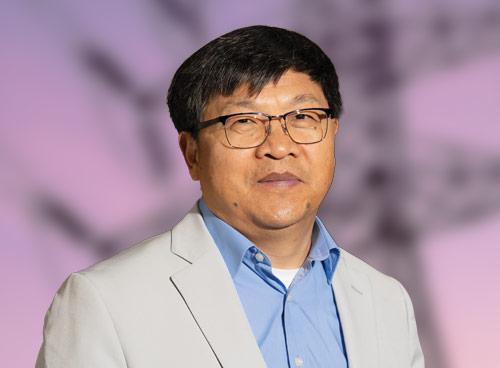
Jason Huang is founder and CEO of TS Conductor, a U.S.-based leader in award-winning, high-performance conductors for global power grids. After earning his MS in materials science and engineering from UCLA and his MBA and PhD from The Ohio State University, Huang worked with U.S. government agencies, including NIST, on sensitive American defense aircraft, and held technical, senior roles at Owens Corning, BAE Systems, Solvay, and CTC Global, where he was CEO and CTO. Today, he is dedicated to driving the global energy expansion, upgrading power grids to increase capacity and efficiency and integrating new generation faster.
The electric grid is facing an absolute tidal wave of new demand from massive data centers and rapid electrification. To keep the lights on and power our future, the industry is completely rewriting the rules of grid modernization.
This month, PUF brings you four innovators who are changing the game from the digital perimeter to the physical edge. We kick things off with Dragos to look at how a rock-solid cybersecurity baseline protects our most automated systems. Next, Rhizome takes us into the world of artificial intelligence to predict macro climate risks before they strike.
Then, TS Conductor drops some serious materials science to show how new wires can double line capacity on existing towers. After that, Osmose shows how to save millions by giving older poles a full second lifespan. Get ready to meet the teams reshaping the modern power grid.
PUF: A pristine risk map is only useful if the circuit can carry the power. Moving from software to physics with TS Conductor, advanced reconductoring looks to double capacity on existing rights-of-way. In an era defined by decade-long greenfield transmission development timelines, how does advanced reconductoring serve as a critical shortcut to effective large load integration?
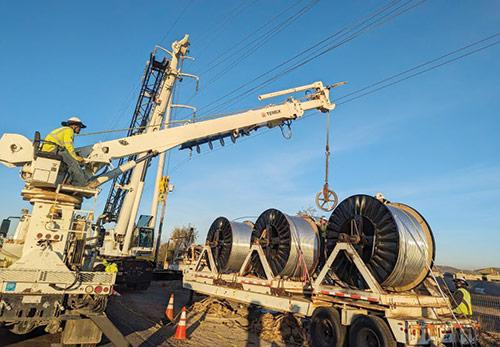 AECC conductors were deployed for Salt River Project’s 8.5-mile reconductoring project in Phoenix, Arizona, in May 2024.
Jason Huang: The grid faces a perfect storm. Over the past two years, FERC’s five-year peak demand forecast has grown fivefold, rising from about 23 gigawatts in 2022 to about 128 gigawatts by 2029 when recent utility and regional planning updates are included. Meanwhile, over 2,600 gigawatts of energy and storage projects sit in interconnection queues – roughly twice the size of the entire existing grid. Current infrastructure cannot keep up.
Transmission capacity is expanding at less than one percent annually – far short of the four to seven percent annual growth needed – driving $11.5 billion in congestion costs in 2023 alone. These expenses are ultimately passed to consumers.
Greenfield development can take a decade, plagued by permitting delays. Advanced reconductoring offers a critical shortcut, replacing outdated wires using existing towers and rights-of-way.
Legacy conductors overheat and sag, and other advanced conductors feature fragile, exposed composite cores prone to installation damage and environmental degradation over time. Next-generation advanced conductors – built with Aluminum Encapsulated Carbon Core (AECC) technology – were designed to solve these challenges.
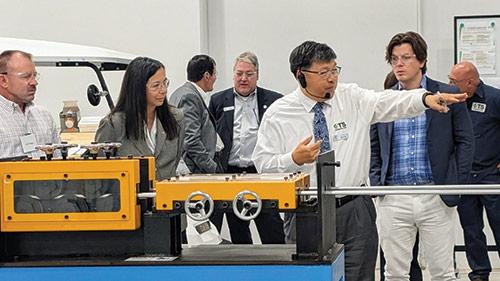 CEO Jason Huang and DOE Assistant Secretary Katie Jereza toured TS Conductor’s new facility.
AECC technology delivers a two- to three-times capacity expansion simply by replacing wires, as we feature ultra-low sag and lighter weight core to facilitate a large TS Conductor option combined with a high emissivity or DLR. Because it exhibits virtually zero thermal sag, utilities completely bypass expensive structural retrofits or tower replacements.
Crews install the technology using familiar, time-tested tools and techniques, with no additional training required. By upgrading the existing grid, advanced conductors slash deployment timelines from decades to months, integrating large loads faster and more affordably.
TS helped MDU reconductor a 230 kV circuit in 2021. Compared to the ACSS option also deployed on part of the circuit, the TS option took about one-half the cost and one-fifth of the time, as TS avoided the tower retrofit required of 50 percent of the structures for the ACSS option.
PUF: First-generation composite cores had issues with field workability and brittleness. How does the encapsulation process solve for field execution risk?
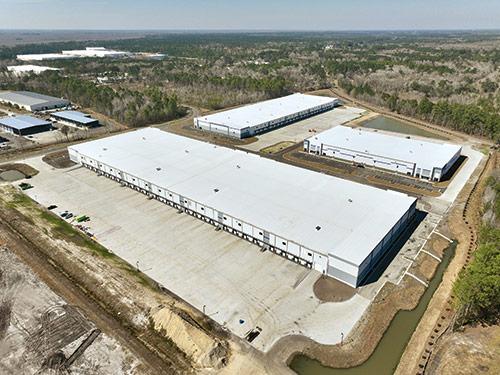 Aerial view of TS Conductor’s new $134 million manufacturing home in Hardeeville, South Carolina.
Jason Huang: TS Conductor designed out the risk, combining superior performance with real world deployability. TS Conductor’s technology overcomes these risks by combining advanced performance with traditional conductor workability.
AECC encapsulates a pre-tensioned carbon fiber core within a thick seamless aluminum layer, paired with annealed aluminum outer strands. The pre-tensioned carbon core prevents compression failures during bending, while the aluminum encapsulation provides mechanical cushioning.
This allows field crews to utilize standard, familiar tools and compression fittings. Structurally, it acts as a seamless environmental barrier against degradation from environmental agents such as moisture, oxidation, UV, and ozone while in service shielding the polymer composite core.
There have been no line failures of energized lines using a conductor made by TS Conductors. Utilities are increasingly adopting this technology as a mainstream solution for major grid optimization, bypassing old infrastructure limitations, delivering massive net project savings, and speed to power even when compared with the ACSS conductor option, which is a 50-year-old traditional conductor solution. The improvement is approximately an order of magnitude when measured using the figure of merit of megawatts delivered per dollar of capital expenditure per month.
For example, Montana-Dakota Utilities reconductored 11 miles of a 230 kV line, avoiding all structural modifications; it increased ampacity by 78 percent, cut project costs by 40 percent, and achieved $1.8 million in savings, finishing a full 15 months ahead of schedule.
Similarly, Salt River Project upgraded 8.5 miles of a 230 kV line in Phoenix under budget, preserving the fifty-year remaining service life of existing structures without the added costs of prolonged outages. Basin Electric Power Cooperative also deployed the technology on a new 27-mile, 230 kV greenfield line; the structural strength allowed for a 15 percent reduction in structure count, from 183 to 155, and shorter tower heights.
These infrastructure savings completely offset the modest material premium, while boosting line capacity by 76 percent to future-proof the regional grid. Utilities worldwide have deployed these conductors across the U.S., Ireland, Vietnam, India, and other nations.

PUF: Why should state regulators view advanced reconductoring as an essential driver of economic competitiveness?
Jason Huang: Texas’ CREZ program is the clearest proof of concept available for what transmission investment can do for an economy. That initiative, which built over 3,500 miles of lines to connect West Texas wind resources to population centers, drove down wholesale electricity costs, diversified the generation mix, and made Texas retail electricity prices among the lowest in the country. It demonstrated that transmission is not infrastructure; it is economic development.
The same logic applies to reconductoring today, but the advantage becomes even clearer when you consider what projects look like on the ground. Building a new transmission line with conventional ACSR can take close to a decade to permit and construct at a cost of roughly $2.5 million per mile and typically delivers a baseline increment of capacity.
By contrast, reconductoring an existing line with an advanced conductor can be completed in a matter of months, often in about three months, at closer to $250,000 per mile, while delivering roughly double the capacity on the same right-of-way.
When you combine those differences – ten years versus three months, millions versus hundreds of thousands, and two times the capacity – the impact compounds quickly. On a capacity delivered per dollar per unit of time basis, reconductoring is not just somewhat better, it is dramatically more efficient – on the order of hundreds of times greater, approaching 800 times by this comparison.
That is why, in an environment where speed, cost, and certainty all matter, reconductoring stands out as the fastest and most capital-efficient way to unlock new grid capacity without waiting for new lines to be built.
A state that can credibly promise power on an accelerated schedule wins that facility, the construction jobs, the permanent operations jobs, the tax base, and the supply chain investment that follows. States that treat transmission modernization as a cost-of-service question rather than an economic competitiveness strategy will find themselves watching that investment land somewhere else.
PUF: How do manufacturing capabilities contribute to near-term transmission system expansion and reliability in the United States?
Jason Huang: The domestic manufacturing expansion is a direct answer to the supply chain vulnerabilities and capacity shortages facing the U.S. power grid. TS is American owned and American operated and has been since day one. TS makes the complete conductor 100 percent in-house. Operating out of Huntington Beach, California, and a newly opened $134 million facility in Hardeeville, South Carolina, TS Conductor continues taking bold steps to secure the domestic supply chain.
For phase one of the three-phase project in Hardeeville, the company is receiving $28 million from the DOE Manufacturing Deployment Office. This expansion scales initial production capacity by up to eight times, and up to twenty times at full buildout. By producing more product, faster, and on American soil, international geopolitical risks and logistical bottlenecks are eliminated, enabling utilities to expand U.S. grid capacity at unprecedented speed.
This domestic output directly drives down net project expenses for utilities. While the technology carries a modest material premium, manufacturing locally slashes lead times and import dependencies. In terms of reliability, high-strength, low-sag cores prevent thermal sag entirely.
This technology also makes them more resistant to heavy loads of winter ice and keeps power lines away from trees in summer heat, mitigating wildfire risk. Operating under high electrical loads, these conductors enhance grid resilience against modern challenges.
By delivering a two-to-three-times capacity increase using existing structures without modifications, the massive savings on structural steel and civil engineering completely offset the material cost of the conductor. In addition to reliability and affordability, this technology exhibits key attributes needed to advance today’s grids, including resiliency, speed to deploy, and safety.
PUF: How can Public Utility Commission policies incentivize utilities to prioritize capacity-efficient technology solutions over familiar incumbents?
Jason Huang: Figure of merit that captures the need for capacity, reliability, affordability, and speed. The wave of state-level mandates requiring utilities to consider advanced transmission technologies represents meaningful progress, but consideration mandates applied at the project approval stage get the sequencing wrong. By the time a project reaches a siting board, the need has already been defined, the scope sized, and the interdependencies locked in through the portfolio planning process.
Planning longer term is necessary to avoid re-reconductoring costs to the ratepayers. Evaluating advanced technology against a pre-defined project scope will almost always produce a negative result. Not because the technology is inadequate, but because the project was designed around different capabilities from the start.
Incentivize utilities to invest in a more efficient solution – not just capital efficiency – such as lower line loss so that more power is available when the grid system needs it. An advanced conductor that would add more capacity than upstream equipment can handle, or that does not deliver incremental benefit because the surrounding system was not planned with it in mind, is not failing on its merits.
For advanced technology consideration to be meaningful, these technologies need to be inputs at the portfolio planning stage, where system needs are still being defined and solutions can be designed around actual capabilities. Regulators should have both the mandate and the authority to ask whether these options were modeled from the start, not appended after the fact.
That said, policy also needs to give utilities more room to innovate. These are organizations whose core obligation is reliability, and deploying unfamiliar technologies at scale carries perceived financial and operational risk.
Rate incentives like Montana’s higher return on advanced conductors are a step in the right direction, pairing the mandate with an incentive for utilities to take the leap. The combination of early-stage planning requirements and financial structures that reduce the downside of innovation is what will move the needle.
PUF: How does your background in materials science and domestic security influence your approach to power line safety concerns, including those driven by extreme weather?
Jason Huang: Working with agencies like NIST and on sensitive American defense aircraft, such as the F-22 and F-35, reinforced that structural integrity cannot be compromised. In aerospace engineering, a material failure can be catastrophic. When attention turned to the power grid, it became clear that critical domestic infrastructure was trusted with century-old technology.
Extreme weather and rising electricity demands are putting immense stress on the grid, magnifying public safety and energy security concerns. Traditional wires overheat and sag dangerously, while first-generation composite cores were too brittle and prone to installation damage.
Designing out a problem is far better than managing one. Applying advanced materials science principles directly addresses these structural vulnerabilities under stress.
By protecting a pre-tensioned carbon fiber core inside a seamless aluminum encapsulation layer, structural forgiveness and extreme durability were built directly into the technology. This configuration eliminates thermal sag entirely, preventing clearance hazards during extreme weather events without needing to rebuild towers.
Just as defense aircraft are engineered to withstand the harshest operating conditions, this technology makes the U.S. power grid efficient, resilient, reliable, affordable, and inherently safe.
Grid conversations at fortnightly.com:
