

A reshuffling of the rankings. Is nuclear the cause?
Herman K. Trabish is a full-time news reporter covering electric utility regulatory proceedings as well as policy issues dealing with renewables, energy storage, and transmission.
As this year's Fortnightly 40 was going to press, presenting our unique analysis of the nation's best-performing energy companies, financial markets in the U.S. and around the world were reeling. Stock prices were gyrating up and down - but mostly down - in the face of three fundamental uncertainties: 1) the health of China's economy, 2) the fate of Greece as an economic player in Europe, and 3) the chance that the Federal Reserve might begin soon to put the gas pedal to U.S. interest rates.

And utility stock prices could claim no immunity against these apparent threats to worldwide economic stability. The Dow Jones Utility Index, up about 28 percent in calendar year 2014, was down about 11 percent for 2015, through the end of August.
But therein lies the beauty of the Fortnightly 40 - now in its tenth consecutive year as a closely watched tool for judging economic efficiency. That's because the F40 listing ignores the day-to-day "noise of markets" by reflecting a four-year average (for the four calendar years that precede the year of publication) of some half-dozen basic financial indices, including an indicator that we label "Sustainable Growth," which is designed to ensure that today's performance has a reasonable chance of being duplicated tomorrow.
Thus, the Fortnightly 40 is grounded on the DuPont model, which measures operating efficiency, asset utilization, and financial leverage, and which was purpose-designed for valuing businesses like utilities. (See sidebar "Behind the Fortnightly 40”)
With that said, let's move on to the numbers. Download a pdf of the Figure 1 ranking table here. To see F40 rankings for the past 10 years, download Figure 2 here.
Dominion Resources fell from number 24 in 2014 to number 57 in 2015, dropping out entirely from the Fortnightly 40. Exelon fell from number 4 last year to number 32 this year, in another precipitous drop. These were the two biggest movements on this year's Fortnightly 40 charts. The falls were all the more striking because both utilities had been consistently highly ranked until just a few years ago.
Exelon had held the second-highest ranking from 2010 to 2011 and was number 1 in 2012 and 2013. Then it fell to number 4 in 2014 before winding up almost out of the F40 this year.
Dominion was number 9 in 2010-11, and its number 24 ranking for 2014 seemed to be a sign that it was on its way back from its drop to number 36 the year before. But in this year's 2015 ranking, Dominion fell even farther and wound up far out of the top forty, at number 57.
Their performances defy the general tendency for integrated utilities with a full spectrum of generation, transmission, and distribution assets to perform best in the Fortnightly 40 evaluation.
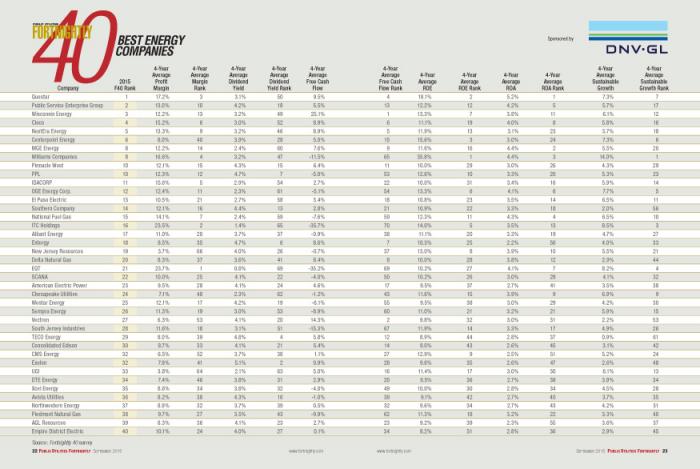 Figure 1 - Fortnightly 40 Best Energy Companies
One of the most striking things these two big movers have in common is a big commitment to nuclear power. With the economics of nuclear looking increasingly dubious, it is hard to see these companies in their current configurations coming back strong - unless the Clean Power Plan changes nuclear power's value proposition.
The biggest move up in this year's listing was made by Avista, climbing 19 places. Clearly, its leadership has been astute in making moves over the last few years, as Avista has climbed steadily. It posted a number 75 ranking in both 2010 and 2009, then went to number 63 in 2012, number 52 in 2013, and - after holding essentially steady at 55 in 2014 - it jumped into the F40 at number 36 last year.
Avista's leaders attribute this impressive performance to one major factor, divestiture of its unregulated business and a return to the area of its historic success in the utility business.
Though still just out of the F40, PNM Resources followed a similar impressive pattern. It was number 82 in 2010-11, 79 and 70 in 2012-13, before moving to 63 in 2014 and 48 this year. The utility is likely beginning to benefit from efforts to sort out its coal holdings and move to the richness of solar in its southwestern region.
EQT Corp. may finally be on the way back toward its former glory. It was in the top 25 from 2006-10, then fell to number 31 in 2011, to number 37 in 2012, and to number 45 in 2013. But it moved up eleven places in 2014 and now ranks No. 21. EQT clearly has prospered from its natural gas holdings and its natural gas delivery capabilities.
Piedmont Natural Gas did not seem to benefit in similar fashion from its gas industry exposure, but that may because of expenses related to pipeline infrastructure investments. It was the F40's third-biggest backslider from last year, falling to number 38 in this year's listing. (See Figure 3; download the figure in PDF format here.) That fall began the year before when, after being in the top 20 in 2011-13, it fell from number 13 to 26 between 2013 and 104. If there is a company in this group that is underperforming, Piedmont could be it.
Sempra Energy moved up to number 26 for this year, a gain of eleven places. Sempra now appears on its way back to the performances that kept it solidly within the top 25 from 2006 to 2012, before dropping into the 30s in 2013-14. With the travails of the San Onofre Nuclear Generating Station well behind it, with new generation and transmission in place, and with the richness of its natural gas supply, Sempra perhaps now stands ready for sustained high achievement.
New Jersey Resources rounds out the patterns shown the Fortnightly 40's top ten movers, having risen from number 29 last year to number 19 in this year's listing. Except for its top-20 rankings in 2009-10, New Jersey Resources has tended to finish outside or almost outside the top 40. It remains to be seen if its natural gas holdings and new renewables ventures will continue to buoy it.
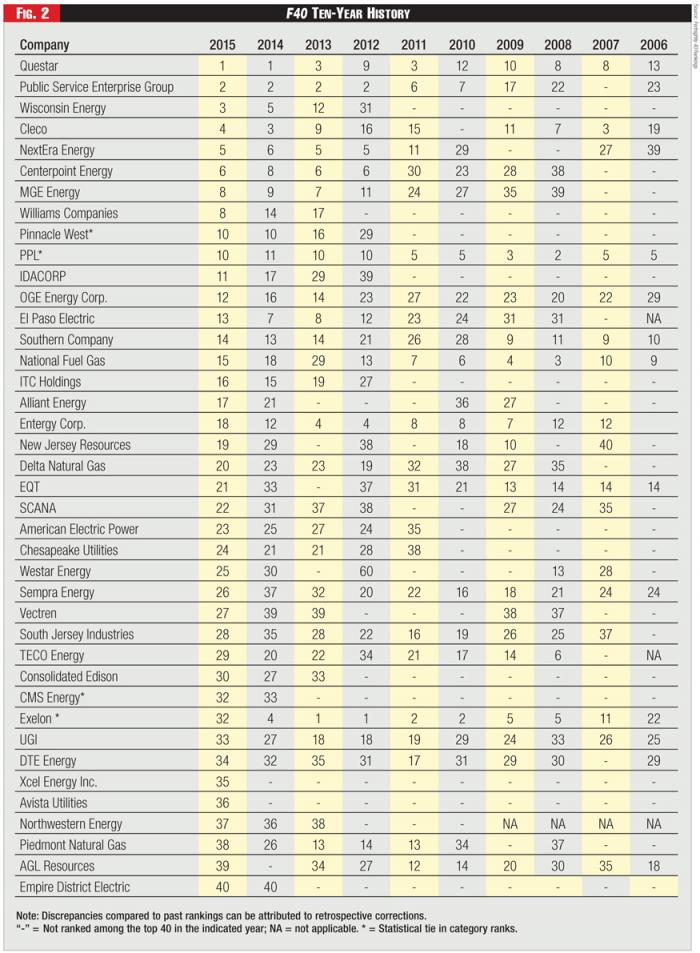 Figure 2 - F40 Ten-Year History
Feedback from Avista shows from where success can come. Sempra offers a rich view into a highly diversified and still successful company. Insights offered by Exelon and Dominion reveal big companies working to overcome hurdles.
Avista - Returning to ‘Pure Play’
The CEO of the best climber in this year's Fortnightly 40 has a simple explanation for the company's performance. "For the first time in a generation, we can consider ourselves close to being a 'pure play' utility," Avista Utilities CEO Scott Morris told investors at the very top of his annual letter.
Within 48 hours in mid-2014, Avista sold Ecova, an unregulated energy and sustainability management business, and bought Alaska Energy and Resources Company and subsidiary Alaska Electric Light and Power, the primary electricity supplier for Juneau, Alaska.
After "tough" years in 2012 and 2013 in which investments underperformed, "we had a transformational year in 2014," said Senior Vice President and Chief Financial Officer Mark Thies.
The company's goals now focus more on what you might call a "pure play" - narrowed to infrastructure investment, technology upgrades, and carefully preparing for "21st century energy delivery," Morris wrote.
Avista Utilities serves 367,000 electricity customers and 326,000 natural gas customers in a territory that covers Eastern Washington, Northern Idaho and parts of Southern and Eastern Oregon. Alaska Electric Light & Power serves an additional 16,000 electric customers in Juneau. The company's financials benefitted in 2014 by a $70 million net gain from the Ecova sale, rate case decisions that went the utility's way in Washington, Idaho, and Oregon, and operating expense management.
The numbers are impressive: (1) Earnings to shareholders of $119.8 million, (2) liquidity of $262.4 million, (3) a $400-million line of credit, (4) a $60-million bond issue for 2044 offered at a 4.11 percent return, (5) a $154.2-million common stock issue with an annualized dividend of $1.27, and (6) the forecast of a continued 4 percent to 5 percent long-term corporate earnings growth.
"We have a higher yield than other utilities," Thies said. "Our board believes we are a 60-percent to 70-percent payout. Our dividend growth will be similar to our earnings growth, a 4-percent to 5-percent rate, because we generate good earnings from our utilities. If financial factors remain the same, we would expect an 8.3-percent to 9.3-percent total return to our shareholders and we believe that is a good value proposition."
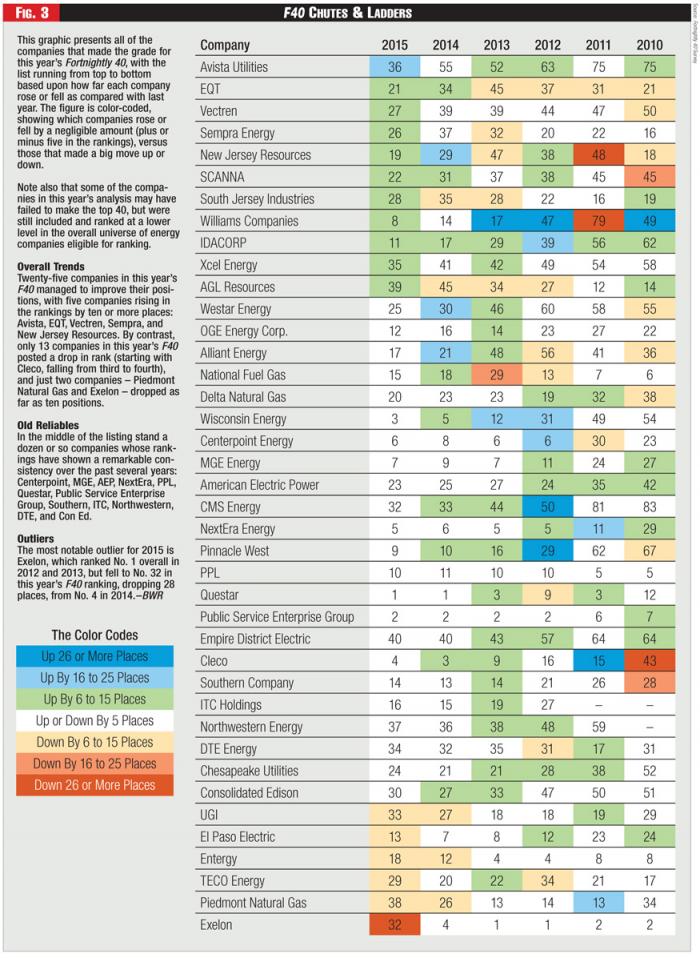 Figure 3 - F40 Chutes & Ladders
With the turn back to its 100 percent utility operations, the company is focusing on across the board upgrades. It began a series of upgrades to its hydroelectric plants on the Spokane River that include new concrete, spillway gates, gate operation systems, and turbines. It is investing $110 million to replace a 20-year-old customer information and work management system and enhancing its website.
"We are spending capital on our system to grow our rate base 5 percent to 6 percent," Thies said. "Our customer and load growth are about 1 percent. Our expenses had been growing at a high rate but we focused on managing that and have it down to a 2 percent to 3 percent cost growth."
Avista also brought on Salix LNG to explore liquefied natural gas (LNG) markets in the West and Pacific Northwest, invested in Plum Energy, which is exploring other opportunities in the natural gas business, and began investigating the possibility or adding natural gas services to its Juneau operation.
"We are spending a lot of time looking at LNG opportunities," Thies said. "With the natural gas price so low, it will make for a diesel substitution strategy in a number of applications."

Avista is not threatened by talk of natural gas price volatility. "There is always some volatility in commodity prices," Thies said. "The long term forecasts show stability. There will be some price increase. But it will likely stay below $5 and it is only when it gets to $8 or $9 that the spike is problematic. Right now, spot prices are under $3. We do expect some event-driven volatility but the price will go back to normal."
Avista's "basic plain vanilla" investment into its system, which its leaders call "blocking and tackling" capital expenditure, keeps the rate base growing at 5 percent to 6 percent to drive earnings growth, explained Investor Relations Manager Jason Lang. "To get that growth, we have to get timely recovery of our cost. So as we deploy capital, we are diligent about filing rate cases."
And though each of the several state public utility commissions that Avista deals with is different, the company's "broad strategy" is to "be reasonable," says Thies. "We ask for a fair return on what our engineers tell us is necessary to maintain the safety and reliability of the system."
The company maintains strong, long-term relationships with each state's commissioners. "When we are not in a rate case, we talk to them. We tell them what we are doing and why it makes sense for our customers," Thies said. "We don't always get what we ask for but we take a collaborative approach."
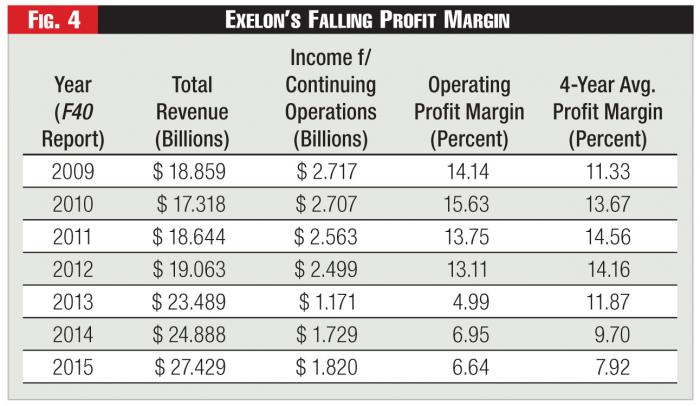 Figure 4 - Exelon’s Falling Profit Margin
Avista was green before green was cool, according to Morris. Long based on the Pacific Northwest's abundant and low cost hydropower, the utility's generation mix is 48 percent hydro, 35 percent natural gas, 9 percent coal, 2 percent biomass, and 6 percent wind.
Washington's Initiative 937 mandates 15 percent renewables by 2020 but does not count existing hydro. But with a wood biomass plant, hydro upgrades that do count, and a 105-MW power purchase agreement it signed in 2012 with the Palouse Wind Project, "we will cover our renewable requirements well into the next decade," Thies said.
It is not currently planning new renewables investments because their assessments do not find them cost effective. "Solar and wind and the other renewable technologies, we look at them all the time, but the least cost opportunity for additional generation continues to be natural gas, not wind and not solar."
The company has, however, recently added a Clean Power Research-developed page to its website that assists its customers in obtaining rooftop solar for their homes and businesses.
"Solar is not the same here in eastern Washington and northern Idaho as in Arizona and California," said Avista Solar Initiatives Manager Kelly Magalsky. "But the utility sees it coming and our customers are getting more interested so we want to be able to advise and help them. The new website helps us have the conversation about whether it makes sense for them. That is what they want," he explained.
"We are in a sea change of customer expectations, technology and the industry as a whole," Morris wrote. Avista is using its smart grid road map to upgrade electrical feeders and "develop a grid that is resilient, efficient and flexible."
Avista also is exploring battery energy storage - "seeking an understanding of how to capture the energy generated by intermittent sources, such as wind and solar, and then distribute it when it is needed."
Sempra - Not the Same Old ‘Songs’
Sempra Energy is a Fortune 500 company with 2014 revenues of $11 billion. It claims 32 million customers in 17 states and 4 countries on 2 continents through four subsidiaries: Southern California Gas (SoCalGas), Sempra U.S. Gas & Power, San Diego Gas & Electric (SDG&E), and Sempra International.
Sempra moved up in this year's Fortnightly 40 from number 37 to number 26, once again approaching the range of the top 25 positions it held from 2006 to 2012.
The best numbers to explain the climb are those cited by CEO Debra Reed in her annual letter to shareholders. In 2014, Sempra "delivered a total return to shareholders of 27 percent and increased our dividend to 5 percent ... [and its] share price reached an all-time high of $116.30."
Its increasing investments in natural gas and natural-gas infrastructure have begun to overcome the burdens of its 21 percent ownership in the San Onofre Nuclear Generating Station (SONGS) and costs associated with its 25 percent ownership in the Rockies Express (REX) pipeline.
SONGS was shuttered permanently in 2013, producing an earning adjustment of $119 million. The adjustment fell to $21 million in 2014. And financial considerations associated with Sempra's REX ownership, through Sempra U.S. Gas & Power, produced a one-time $214 million earnings impairment for 2012.
Thus, while Sempra took a hit in 2012 for its involvement in REX, it is now preparing "to take advantage of new market demand," Reed wrote. As a result, total earnings rose from $859 million in 2012 to $1 billion in 2013 to $1.16 billion in 2014.
Although SDG&E will continue to face costs such as those for decommissioning related to SONGS, the 2014 settlement reached with the California Public Utilities Commission (CPUC) allows for the recovery of a portion of the losses retroactive to 2012.
“SoCalGas and SDG&E are the bedrock of Sempra Energy’s business,” explained Vice President, Controller, and Chief Financial Officer Bruce Folkmann. “Combined we are investing approximately $12 billion over the next five years to enhance safety and reliability, meet state environmental policy initiatives, and adopt new technologies.”
California’s SDG&E, Sempra’s biggest subsidiary, serves the County of San Diego and an adjacent portion of southern Orange County. It provides electricity to 1.4 million metered customers and natural gas to 0.9 million metered customers. Its 2014 operating revenues were $4.3 billion with earnings of $507 million.
At the end of 2014, Sempra had 2,100 miles of transmission lines, 23,000 miles of distribution lines, and associated infrastructure. It also had two natural gas compressor stations, 170 miles of transmission pipelines, 8,600 miles of distribution pipelines, and 6,500 miles of service pipelines. In July 2015, SDG&E became the first of California’s three dominant electricity providers to meet the state’s 2020 mandate to obtain 33 percent of its generation from renewables. Approximately 60 percent of its generation comes from natural gas.
SoCalGas, Sempra’s second biggest business segment, stands as the biggest U.S. natural gas distribution utility. Its 5.9 million metered customers include 5.6 million residential, 246,800 commercial, 27,000 industrial, and 50 electric generation and wholesale meters.
In 2014, SoCalGas added 26,000 new metered customers for an annual growth rate of 0.4 percent. With new housing starts in its service territory up slightly, it expects a slightly higher growth rate in 2015. The SoCalGas 2014 net income was $322 million. Total assets at the end of Q1 2015 were $10.6 billion.
Facilities at the end of 2014 included 11 compressor stations, four storage facilities with 137 billion cubic feet of natural gas storage capacity, and 100,000 miles of natural gas transmission (2,960 miles), distribution (50,001 miles), and service (47,517 miles) pipelines. About 93 percent of its natural gas supply is imported from outside California.
In 2014, Folkmann reported, the CPUC approved SDG&E’s state-of-the-art South Bay Substation relocation project, which will further the utility’s ongoing efforts to meet load without SONGS. It also expanded its Borrego Springs Microgrid, the biggest U.S. microgrid in capacity and participating customers. Borrego Springs incorporates solar, energy storage, and automated switching, and can interconnect with SDG&E system or operate independently during emergencies.
SoCalGas continued working on its $200 million-plus Aliso Canyon Turbine Replacement Project and toward its goal of replacing 6 million meters with Advanced Metering Infrastructure by 2017. And the company’s $1.3 billion capital plan includes a CPUC-approved Pipeline Safety Enhancement Plan (PSEP), the largest capital project in Sempra’s history, according to Folkmann. It also includes the advanced meter installation, the Aliso Canyon Turbine Replacement Project, and other system upgrades.
For 2015, Folkmann said, SDG&E remains focused on executing on a $1.1 billion capital plan that includes grid modernization, natural gas system safety enhancement, and winning CPUC approval for its proposal to install 5,500 utility-owned EV chargers on time-of-use rates.
Both utilities – gas and electric – will be thinking ahead in the coming years to California’s pending move to increase its renewables mandate to 50 percent by 2030. That will entail new renewables generation and quick-start natural gas capacity to support it, Eisen pointed out. And the state’s new target of cutting transportation petroleum use by 50 percent will offer Sempra the opportunity to work on transitioning heavy duty transportation fleets from diesel to natural gas. California’s distributed energy resource mandate will give Sempra the opportunity to explore fuel cells, combined heat and power, micro turbines, and more energy-efficient technology, Folkmann believes.
Folkmann foresees two important challenges ahead for SDG&E. One is obtaining regulatory approval for its capital projects. The other is initiating the implementation of a major CPUC-imposed rate structure that will collapse the current four tiers to two by 2019.
Among California’s demanding energy policies that will affect SDG&E are Assembly Bill 327, which reforms the electric rate structure and opens the way for renewable and distributed generation. There is also a mandate for eliminating fossil generation that pollutes the state’s waters, another that sets a minimum target for community solar, and another that sets utility requirements for energy storage.
Natural gas policies that will impact SoCalGas include a requirement to assess the cost of generation needed to accommodate 50 percent renewables, a law that opens the way for compressed natural gas and liquefied natural gas if they are priced transparently, and another supporting the deployment of natural gas vehicles.
Finally, Assembly Bill 802 will facilitate the growth of building energy efficiency programs by utilities.
These are burdensome to utilities but they also offer opportunity. In response, SDG&E is planning a 2015 to 2019 $5.8 billion capital program. SoCalGas’s is closer to $6 billion.
“We expect to achieve compound annual growth in earnings per share of approximately 11 percent from 2015 to 2019 – about twice the growth rate you would expect to find in the utility sector,” Reed wrote in her letter. “I could not be more excited about the many great opportunities ahead of us.”
“Innovation is essential to our company,” Folkmann explained. “We must think creatively to address new challenges and opportunities.”
Lead image © Can Stock Photo Inc. / tolokonov
