
Oracle
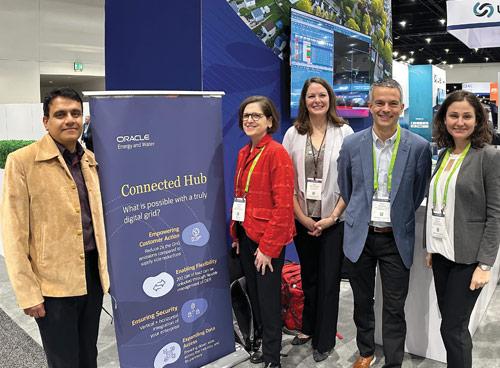
At Oracle, Brad Harkavy is Energy and Water Global Head, Sameer Kalra is Energy and Water Director Operational Technology, Allison Salke is Energy and Water Sr. Product Marketing, and Mary Sprayregen is Utilities Sr. Director Regulatory Affairs.
This year, DistribuTECH International had a theme of "Experience the Energy Movement," with thirteen educational tracks and a massive exposition floor holding over five hundred booths. The PUF team met up with innovators making a difference with emerging technologies useful to the grid space.
PUF's Steve Mitnick: Brad, you just gave a presentation on big developments from Oracle. What were the high points?
Brad Harkavy: The presentation was about what's happening with DERs and the fact that electrification is increasing sharply. There's massive investment in clean-energy companies.
Electrification is going to have a huge impact on the grid. The fact that the federal government is injecting billions of dollars into this industry is going to make the lives of all the folks we do business with exponentially harder. As a software vendor, that's exciting.
We can help add value to our customers in times of step function changes. As we think about our product lines, there are megatrends that impact everything we're doing.
PUF: What is Oracle doing about these megatrends?
Brad Harkavy: With these megatrends, we have acquired a bunch of technologies over the years to service the energy and water ecosystem. All of those businesses are starting to converge.
We need solutions that extend from our customer business through energy efficiency and behavioral demand response all the way into hardcore grid asset management and analytics.
We're calling this comprehensive solution, Enterprise DERMS. Enterprise DERMS is building on our core strength, which starts with modeling all the renewables on the grid and orchestrating it in real time. It's starting to touch the customer experience by incorporating customer and program management
From a big picture view, the government incentives encourage people to reduce their carbon footprint by buying electric vehicles, doing energy improvements to their houses, putting in mini-splits, and getting people to take action.
At Oracle Energy and Water, we're implementing an Enterprise DERMS system for a major U.S. utility that extends from engaging customers into a program, so they've got to sign up for a thermostat. They have to manage that thermostat, so the asset management system has to figure out where that thermostat is, what firmware is running, what programs the thermostat is enrolled in, and when the thermostat should be replaced.
It extends into Oracle's billing system, so we can understand how to pay them for demand response events, and what the benefit is.
It extends into our grid management software because we have to model and predict what the propensity is for someone to engage in one of these behavioral or automatic programs, and then what the impact is on the grid, whether we're going to get enough capacity to load shed from the demand response event, as we're modeling on the grid. We're carving out a position that's unique in the industry because of the breadth of what we're doing and because of where the market's going.
PUF: What are you talking about at this show, at Distributech?
Sameer Kalra: Let me step back a little. Having spent ten years with a utility, I joined Oracle about a year ago from Pacific Gas & Electric, I saw the pain points the utilities are in. By joining Oracle, I want to take those pain points and figure out how to build software that addresses those pain points.
Thinking broadly, decarbonization is a huge trend now. How do we, by 2050, achieve a renewable portfolio standard reaching a hundred percent renewable on the grid?
The grid has been in a transition for a long time. We have gone through the transition from fossil based to renewable based. We are building the critical software to smooth the energy transition.
With ADMS, advanced distribution management software, DER management software, analytics on data science on top of it, all of those are helping move forward. We are showcasing these products and services here.
We are announcing the launch of a Grid Edge DERMS and a digital asset management solution for customer-owned DERs. Using built-in AI and machine learning, the Oracle solutions allow utilities to better monitor, control, and optimize behind-the-meter devices. The way we are differentiating is there's an operational DERMS component that is part of our ADMS product that focuses on orchestrating and providing flexibility in front-of-the-meter assets, such as grid-scale batteries, solar, and storage.
Then, Grid Edge DERMS provides the same flexibility for behind-the-meter assets, such as thermostats, batteries, like the Tesla Powerwalls, and energy storage behind the meter, in electric vehicles, for example.
By combining the grid side with the customer side, we are creating the whole demand flexibility, end to end. There's no vendor I can see, anywhere, that can do that today. We called this cross-functional solution, Enterprise DERMS.
Brad Harkavy: It's important to realize for the kind of problems we are solving there is no one vendor that can provide a monolithic solution. It doesn't work. They're much too complex. People have huge investments in their legacy software that they're not going to throw out.
What we're building here is a composable and modular architecture. It's important, in the breadth of our offering, that we can offer domain experience in a unique way.
Even if you're not buying our solution, we understand how all of those other pieces work together, and we can integrate with existing products. That's a big part of our value.
I don't, in any way, want to imply that Oracle has this expectation that we're going to be a one-monolith provider for any of this, because it's too broad a problem for anyone.
Sameer Kalra: Another key piece of software we are launching here is Flex SCADA. For DERMS, you need to bring the data from front-of-the-meter, grid-scale assets, and also from behind-the-meter customer-owned assets.
Oracle did an acquisition a couple of years ago of LiveData Utilities. There's nobody in the industry who can claim to have the same kind of an operational technology message bus that is bringing in the data from behind-the-meter assets as well as front-of-the-meter assets in a unified way.
It's a single ingestion layer that can serve up all the data to the ADMS, as well as other DERMS components. We are launching Flex SCADA here at Distributech.
The uniqueness of that layer is because, coming from a utility, from each type of assets, we had to build a separate data silo. In this case, now we have a single ingestion layer. We have a common data platform that underpins all of this, DERMS and ADMS.
From a utility perspective, we are solving their pain point of a single data platform where they can build insights on top of it, and then they can generate actionable insights.
Brad Harkavy: Oracle legitimately had a hole in our product offering in that we didn't offer a SCADA product. That's part of what we're announcing, is a culmination of a lot of work, the acquisition of my old company, which was LiveData Utilities, and hiring the dream team of SCADA developers from our competitors so we could develop a robust, modern next-generation SCADA product.
PUF: What do you do at Oracle and what are you talking to people about here?
Allison Salke: I'm a product marketing manager. I talk about the operational technology products, the products we're showing here. I have the best job because I get to share all of the great work that everybody does — customers and our product teams. I get to talk about results that we deliver.
We've heard a lot about data and solutions, but it's not just data. It's the knowledge and insights that we gain from data and the way we get to operate the grid more efficiently and reliably, our customers get performance incentives, and our customers can deliver more reliable power to their customers, respond to storms more effectively, and reduce outages.
The customer-to-grid side is an essential part of our DERMS solution because for DERMS, the S in DERMS is system. That system means participation by everybody, the utility and the customers.
Sameer Kalra: As one example in action, we recently announced Dominion Energy Virginia chose Oracle's ADMS system to help with increasing service reliability and reducing the customer interruption minutes. The utility is deploying our FLISR product for fault location, isolation, and service restoration, and our OMS outage management system.
Last year, the utility had selected another vendor that could not deliver. They stopped that project halfway and partnered with Oracle due to our solid innovation and delivery track record.
Oracle was working with Dominion Energy to manage switching for many years. They saw how responsive we are, our customer service, product performance and its delivery, was top notch across all the ecosystem of vendors.
They talked to our previous customer, FirstEnergy, which deployed ADMS for six million customers across ten operating companies. Oracle implemented such a complex project on time and on budget which is rare in our industry.
PUF: What is going on with Opower?
Mary Sprayregen: My Distributech session is on regulatory paradigms and the utility of the future. I've been thinking a lot lately about this topic and the unique position utilities are in with consumers. Brad talked earlier about how the convergence of Oracle solutions is helping us extend our technologies from our customer business to hard-core grid asset management and analytics.
Opower brings AI and behavioral science into the utility customer experience and influences customers to act on an enormous scale. Our programs help electric and gas companies across the U.S. drive energy efficiency and support decarbonization initiatives, while also tackling the critical issue of energy affordability.
For example, on affordability, our solutions help utilities deliver innovative limited income solutions to support their customers. We do this through predictive analytics that help identify financially vulnerable customers, send personalized messages that help increase awareness and adoption of these programs, and provide a streamlined enrollment process.
We talk a lot about exciting stuff that's out there for in-home devices. People are getting into smart homes. But what about everybody else as we transition through decarbonization, through electrification, and the scale that a utility customer relationship can provide?
We worked with The Brattle Group to try to quantify that. What kind of scale can you reach if utilities effectively activate everybody? How do you reach everybody?
The climate and grid flexibility impact that people can have when you activate them together at scale is massive. Small things together make a big difference.
We found with Brattle that consumer-driven action from utility programs, getting people to do energy efficiency behind the meter solar, home and vehicle electrification, that value is nearly twice the value of supply-side decarbonization alone. I'm trying to get people to think more about that underestimated potential that exists in everyday people, if leveraged in an effective way. Now we need utilities and their regulatory stakeholders to shift how they view investments in customer action. Effectively engaging and activating utility customers should be central to any decarbonization pathway.
Lead image: From left, Sameer Kalra, Allison Salke, Mary Sprayregen, Brad Harkavy, and Hillary Martin.
DistribuTECH International conversations at fortnightly.com:
- ABB's John Hayter, Nedra Hurley
- Accenture's Patrick Aluise
- AiDash's Abhishek Singh
- AVEVA's Ann Moore
- Bentley Systems' Joe Travis, Brad Johnson
- Bidgely's Gautam Aggarwal, Maria Kretzing
- Capgemini's Hari Krishnamurthy
- FLO's Chris Thorson, Frank Fata, Nathan Yang
- GE's Mahesh Sudhakaran
- Hitachi's Anthony Allard
- IBM's Casey Werth
- OATI's Mary Brown, Ali Ipakchi
- Oracle's Brad Harkavy, Sameer Kalra, Allison Salke, Mary Sprayregen
- PXiSE's Patrick Lee
- Toshiba's Jeff Simmons
