Transactions
(April 2010)
(April 2010)
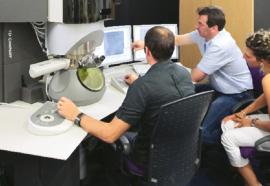
FEI Company, a diversified scientific instruments company providing electron and ion-beam microscopes and tools for nanoscale applications, completed a multiple system installation at the Materials Ageing Institute (MAI) in France, a utility-oriented research center financed by Electricite de France, the Tokyo Electric Power Co., the Kansai Electric Power Co. and the U.S. Electric Power Research Institute.
New turbine technologies offer unprecedented flexibility.
If there’s an electric power project under development that best reflects the current state of the U.S. gas turbine market, it might be the Northern California Power Agency’s (NCPA) 280-MW, natural gas-fired combined-cycle plant in Lodi, Calif.
(May 2010)
Get ready for fundamental changes.
In almost all business and non-profit environments, change is occurring at an accelerating pace. In the electric industry—which used to be stable—we are seeing major changes too. Utilities face growing ambiguity as well as increasing paces of change, uncertainty and complexity. As Irene Sanders stated in Strategic Thinking and the New Science, “[t]hat the future will be different from today is given. What we struggle with is our desire to know how it will be different and what we can do to influence it.”1
Constitutional questions about state-mandated renewable tariffs.
Despite state efforts to follow the European model of state-mandated feed-in tariffs to promote renewable power, these actions won’t pass Constitutional muster. The Supremacy Clause makes a formidable legal barrier to states’ FIT policies.
Whistleblowing case has ramifications for an entire industry.
Should whistleblower-protection provisions of the federal Energy Reorganization Act protect an employee of a small firm that has a staff augmentation contract with a regulated nuclear energy technology company? The battle of the briefs has been blazing in a federal case set to answer that question.
Small is beautiful for nuclear developers.
Small modular reactors (SMRs) are nuclear generating units that are about the size of railroad cars and provide about one-tenth to one-fourth the power of full-size reactors. As a result, they cost a fraction of what full-size reactors cost. The reactors are designed to provide between 40 MW and 300 MW of electric power, compared with the 1,100 to 1,700 MW output of larger reactors. In addition, most are expected to cost under $1 billion, compared with the $5 billion to $10 billion price tags of the larger units.
Capacity planning for the smart grid.
The one-day-in-10-years criterion for capacity planning is coming under scrutiny. Making the most of the smart grid and demand management requires a less conservative approach. Markets and prices rather than administrative rules will ensure resource adequacy in a more efficient way.