

Women's History Month
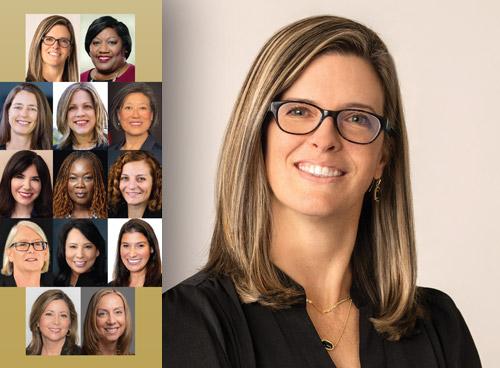
Alice Yake (Jackson), Vice President of GRIDS at Breakthrough Energy, leads efforts to develop an open-source modeling ecosystem for delivering reliable, low-emission electricity globally, addressing the complexities of system design, regulations, and zero-carbon goals. With 25 years of industry experience spanning Enron, Oxy, and Xcel Energy, she applies her expertise to advance scalable, data-driven solutions while balancing her mission-driven career with her role as a mother and stepmother.
In recognition of Women’s History Month, PUF sat down with thirteen women leaders across the energy sector to capture their perspectives at a pivotal moment for our industry.
Demand is rising. Infrastructure investment is accelerating. Utilities, regulators, and innovators are navigating increasing expectations around affordability, reliability, and resilience. In this environment, leadership is not theoretical. It is operational. Decisions made today will shape markets, systems, and communities for decades.
The women featured here represent the breadth of the modern grid. Their roles span utilities, regulatory commissions, federal public power, trade associations, research institutions, consumer advocacy offices, and technology companies. The perspectives are varied, but several themes recur: translating complexity into clarity, balancing competing priorities, preparing the workforce of the future, and keeping customers at the center of the conversation.
These conversations are not a single narrative. They are a collection of viewpoints reflecting the realities of leadership in motion. Together, they offer insight into how this essential industry is being guided forward at a time of significant change.
PUF’s Rachel Bryant: When you look back at your path into energy, what moments or experiences most shaped the leader you are today?
Alice Yake: I was reflecting on that recently, and I actually made a list of every job I’ve ever had. Not just my formal W-2 jobs, but the early ones too. And when I looked at it, I realized every single role contributed something to how I lead.
Before energy, I worked as a ballerina, runway model, lifeguard, pharmacy technician, and even in multilingual customer support. Later came Enron, Occidental Petroleum, Xcel Energy, and now my current role. On paper it may look eclectic, but each experience taught me something about responsibility, authority, and collaboration.
Lifeguarding, for example, is about safety, but it is also about managing people. You are young, yet you are responsible for enforcing rules and maintaining order. Ballet taught me something different. To lead and follow at the same time. You have a director and choreographer but also have partners. You learn discipline, awareness, and how to operate within a structure while still bringing your own judgment.
Those early roles helped me understand that leadership is not about one person commanding everything. It is about direction, vision, and trust, combined with independent thought and accountability.
PUF: You are widely known for your time at Xcel Energy. How did that opportunity come about, and how did it shape your sense of purpose?
Alice Yake: My move to Xcel was not something I mapped out years in advance. I was at Occidental Petroleum at the time. Oxy was one of Xcel’s largest customers, and we were deeply involved in managing electricity costs.
I had a technical background in management information systems and programming. I built billing and settlement systems. I ran a retail electric provider. I was trading renewable energy credits and managing interconnections.
When Xcel called and asked whether I would consider moving to the utility side to run regulatory, it was unexpected. But regulatory is where you truly learn how a utility works.
It is where strategy, operations, and accountability converge. You have to tell your regulator almost everything you do, which requires you to understand the business from end to end.
At first, it was simply an opportunity to grow. But early in my time there, something shifted for me. I realized there is no other job where you can impact as many lives as you can in a utility.
If you do your job well, you are serving millions of people. Electricity is essential to life. That realization turned what had been a career into a purpose.
PUF: In your current role, you are focused on global grid modeling and accelerating infrastructure planning. What drew you to that mission?

Alice Yake: Each role in my career has prepared me for the next one, even when I did not realize it at the time. As chief planning officer at Xcel, I oversaw teams responsible for generation, transmission, distribution, and gas infrastructure planning.
We worked to integrate those disciplines so that planning was not siloed. Instead of labeling a problem as a transmission issue or a generation issue, we asked what the optimal solution was across the system.
What became clear was how cumbersome and slow modeling tools can be. Running a single model could take months to set up and days to execute. Expectations from outside stakeholders often did not reflect that reality. There was a disconnect between what people assumed was possible and what actually was.
When I was approached about helping make grid modeling more accessible globally, I saw the scale of the opportunity. There are hundreds of millions of people worldwide without electricity and billions more with unreliable service. Planning bottlenecks are a major barrier to progress.
Our mission now is to reduce the time it takes to reach infrastructure investment decisions. That is not just a technical problem, it is a human one. Trust, culture, and alignment matter just as much as the tools themselves.
PUF: You have moved through increasingly senior leadership roles. How has your approach to leadership evolved?
Alice Yake: Leadership becomes lonelier as you move up. That is simply reality. Fewer people can see what you see, and fewer people can safely be sounding boards. One of the most important lessons I learned was the need to cultivate trusted relationships, both inside and outside the organization.
You need people who can challenge you, ground you, and sometimes just listen while you work through a complex problem out loud. Those relationships are invaluable.
Another lesson was learning to transition from subject matter expert to leader. Early in my career, I was comfortable being the technical expert. But when leading large teams, you cannot know everything. Others must be trusted to be the experts.
That shift is difficult, particularly for analytical personalities. It requires humility and confidence at the same time.
As a leader, you set vision and direction. But you also advocate for your people. You must understand their capacity, their challenges, and their humanity. Data matters, but so does empathy.
PUF: What advice from mentors has stayed with you?
Alice Yake: One of my most influential mentors was my former boss at Oxy. He took risks on me early in my career and put me in challenging situations. Sometimes he let me stumble, but only when the lesson would be valuable and the consequences manageable.
His best advice was simple: read everything. In negotiations and complex discussions, most people have not read the full contract, the tariff, or the filing. If you truly understand the material, you have an advantage. That discipline has served me repeatedly throughout my career.
He also modeled something equally important: investing in people. He gave me opportunities before I was entirely certain I was ready. That trust shaped how I think about developing others.
PUF: From your vantage point, what is the most pressing challenge facing the energy sector?
Alice Yake: Trust. We are entering a period where aging infrastructure must be replaced at scale. Much of our system was built decades ago. Straight line depreciation tells the story. Assets are reaching the end of their useful life, and replacement will cost more.
At the same time, the future grid will not look like the past. Electrification, digitalization, and evolving customer expectations require different solutions. Planning requires informed assumptions, and no model is perfect. Every model is wrong to some degree. The question is whether it is directionally useful.
If regulators, utilities, and stakeholders do not trust one another, it becomes extraordinarily difficult to make the investments necessary for the next generation. Without alignment, progress slows.
We need better conversations about reality. Energy prices are unlikely to decrease in the near term given the scale of infrastructure replacement required. The real question is how to manage costs responsibly and equitably.
PUF: As we celebrate women in leadership, what advice would you offer to those aspiring to senior roles?
Alice Yake: There are two things I would say. First, early in your career, particularly in technical fields, you may feel the need to constantly prove your expertise. That instinct can serve you well initially.
But there is a tipping point. As you move into senior leadership, you no longer need to prove that you belong in the room. Continuing to over-justify yourself can unintentionally undermine your presence. It is important to recognize when you have earned your seat.
Second, when you are in the room, speak. You were invited for a reason. Be respectful, be prepared, but do not remain silent out of hesitation.
Leadership requires courage, particularly when navigating complex systems. The industry is evolving, and diverse perspectives strengthen decisions. Women bring critical insight to these conversations. The more we normalize that presence, the better our outcomes will be.
Women’s History Month articles at fortnightly.com
- Doseke Akporiaye, WRISE Executive Director
- Hannah Bascom, Uplight Chief Growth and Commercial Officer
- Michele Beck, Utah Office of Consumer Services Director
- Vittoria Bellissimo, CanREA President and CEO
- Judy Chang, FERC Commissioner
- Neva Espinoza, EPRI Senior Vice President, Energy Supply, and Chief Generation Officer
- Sonia Kastner, Pano AI Co-Founder and CEO
- Maria Korsnick, Nuclear Energy Institute CEO
- Tracey LeBeau, WAPA Administrator and CEO
- Michele O'Connell, Orange and Rockland Utilities CEO
- Ann Rendahl, NARUC President
- Melissa Washington, ComEd Senior Vice President
- Alice Yake, Breakthrough Energy Vice President, GRIDS
