

Fortnightly’s Executive Roundtable considers industry options and risks.
Michael T. Burr is Fortnightly’s editor-in-chief. Email him at burr@pur.com
Rapid changes in electric power markets are posing real-time challenges for operators of generating facilities across the country. Green energy mandates are driving expansion of variable generation. Shale gas reserves have pushed fuel and electricity prices to historic lows, just as new environmental rules are putting pressure on fossil-fired plants. Baseload facilities, designed to operate virtually 24/7, now are cycling to accommodate market fluctuations. And distributed generation, storage, and demand-side management are changing the way electricity is sold and distributed.

Last fall, with the support of exclusive sponsor Invensys, we launched a new online publication to focus on this range of issues, specifically as they pertain to the generation side of the business. In Fortnightly’s Power Profit we present the perspectives of leaders in the field about trends in asset optimization, resource planning, and risk management. Last October in Washington, D.C., we convened a roundtable meeting – comprised of senior operations executives at a range of power companies – to address these topics as a group. Additionally, Federal Energy Regulatory Commissioner Tony Clark dropped in to deliver the keynote address (see sidebar “Jurisdiction Junction: FERC’s Tony Clark”).
During the Fortnightly’s Power Profit executive roundtable, participants discussed the challenges of running long-term assets in a real-time world – and several agreed to let Fortnightly report some of their comments. They include:
• Paul G. Afonso, Partner, Brown Rudnick, and Executive Director, New England Energy Alliance;
• Jacob A. (Lon) Bouknight Jr., Executive Vice President and General Counsel, Public Service Enterprise Group;
• David A. Christian, Executive Vice President, Dominion Resources, and CEO, Dominion Generation Group;
• Hector Puente, Senior Vice President and COO, El Paso Electric;
• Thomas M. Rainwater, President and CEO, Essential Power; and
• Peter Martin, Vice President, Invensys Software and Industrial Automation, and Fellow, International Society of Automation.
Transition Planning
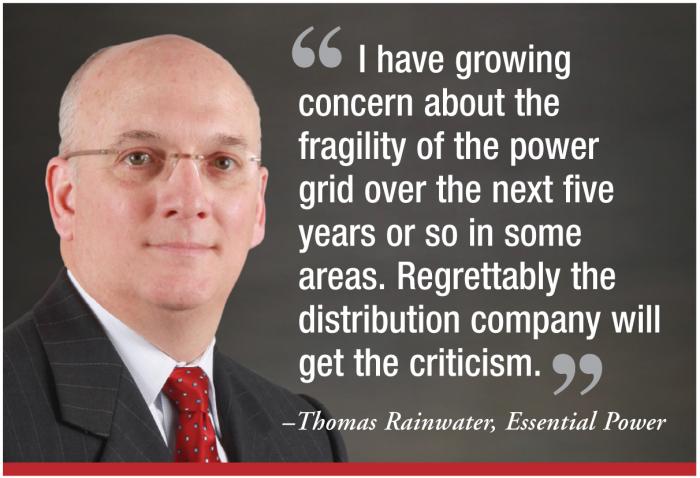 "I have growing concern about the fragility of the power grid over the next five years or so in some areas. Regrettably the distribution company will get the criticism." - Thomas Rainwater, Essential Power
Michael Burr, Fortnightly: The power industry is going through some fundamental transitions, but it’s still uncertain which changes will prevail and what will result. If you had a crystal ball that could show you what the U.S. power market will look like in 10 years, how do you think that view would differ from today’s market?
Tom Rainwater, Essential Power: I’m hearing a growing concern from some within our industry and particularly from new entrants that the traditional model enjoyed in this industry is in jeopardy of becoming technologically obsolete. There are parallels to other industries such as computing. In our country we’ve migrated from mainframes to micro computing. We abandoned the central-office landline telephone model for a distributed mobile telecom model, and in emerging economies they’ve completely leapfrogged the landline telephony model and gone straight to mobile smart phones and mobile computing. Our smartphones are more powerful today in many instances than mainframes were a few years ago. Is it possible that distributed generation ultimately could leapfrog the business model of central generation, transmission, and distribution? Is this unlikely or a fundamental risk that we as executives in this industry need to confront?
Hector Puente, El Paso Electric: Thirty years ago, some people were predicting that cogeneration would take over our business. Many customers who installed cogeneration couldn’t keep it going. They learned it was high maintenance, and they went back to being traditional customers. Distributed generation could follow a similar pattern. Customers might see renewable generation systems degrade every year, in terms of output, and if rates don’t accurately reflect the cost of backing up renewables, we could have the problem of taking from the poor to subsidize the more affluent customers who can afford renewable sources.
These are real issues, but the more we raise them, the more people seem to think we’re hiding something or trying to control the market.
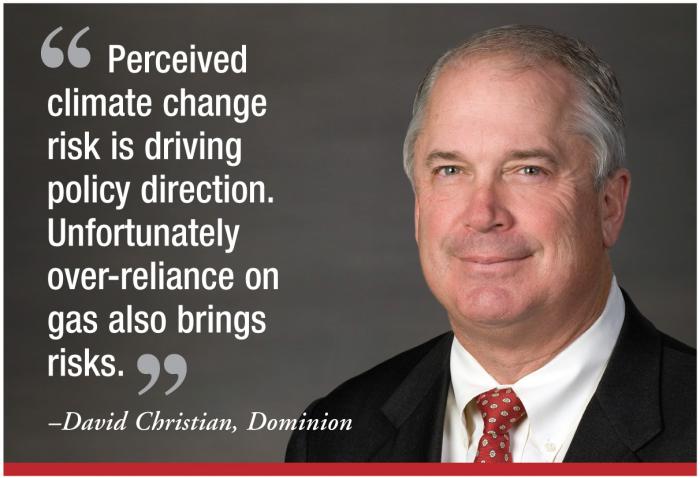 "Perceived climate change risk is driving policy direction. Unfortunately over-reliance on gas also brings risks." - David Christian, Dominion
The other real issue is the impact of distributed generation to system reliability. When there are rolling blackouts, utilities are blamed. The regulator doesn’t go to the DG-owning customer and say, ‘Why were you off grid?’
We need to hold policymakers’ feet to the fire. We either need a national energy policy, or we need the ability to take care of our customers’ needs with the most cost-effective and reliable sources of power. If we are going to have an energy policy, it should include solar, wind, nuclear, and also coal, because we have a lot of it.
Afonso: The pendulum is swinging again, and actions taken today will affect us four or five years from now. How do you place a value on things like environmental benefits and economic development? New England is coming to the point of saying ‘no’ to any fossil fuel, including natural gas, on the assumption that renewables will be sufficient to meet our energy and reliability needs. But everything is a choice and everything has a cost. If it’s windmills, then you have to build a transmission line.
If you’re a regulator or elected official, you must have the courage to take a long-term view – balancing reliability and renewable policies and taking a more integrated point of view – even if it comes with a short-term political hit.
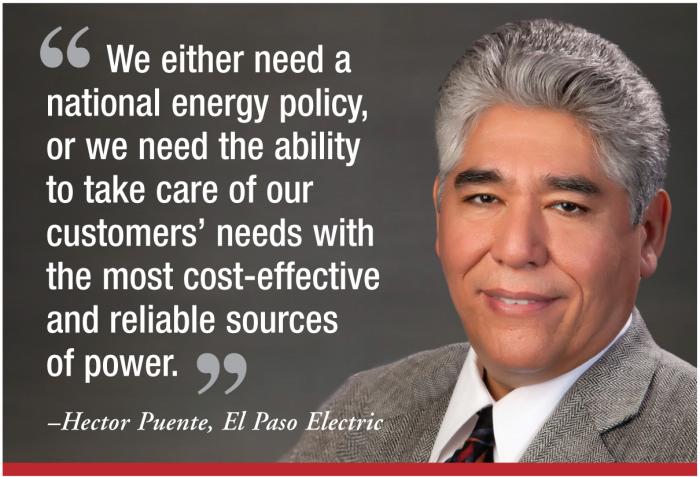 "We either need a national energy policy, or we need the ability to take care of our customers’ needs with the most cost-effective and reliable sources of power." - Hector Puente, El Paso Electric
We’ve seen long-term contract decisions coming out of Maryland and New Jersey [driven by state agencies]. Could contracts like that be used for renewables and be subject to the same legal attacks regarding long-term contracts?
Lon Bouknight, PSEG: It’s important to keep PURPA in mind when talking about renewables. PURPA [the Public Utility Regulatory Policies Act] is a statutory exception to the Federal Power Act. It delegates authority from the states to the federal government. That might involve different rules.
Gas Reliance
David Christian, Dominion: In 10 years the U.S. will be much more dependent on natural gas. EPA’s 316(b) and new source review (NSR) regulations could drive off an additional 20 to 30 GW of coal or nuclear. After the Kemper and Edwardsport projects, there will likely be no more new coal in the United States. Will the other markets for new natural gas capacity materialize? Will the re-industrialization of the U.S. really occur like some people say it will [because of low-cost natural gas], with new chemical and plastics plants in Ohio and in the Gulf region? It’s not clear to me they will jump in. They might wait to see how the electricity situation, with substantial new inelastic natural gas demand, plays out.
Perceived climate change risk is driving policy direction. Unfortunately over-reliance on gas also brings risks, in terms of price volatility and potential supply interruptions. Electricity prices going up isn’t seen as an important risk.
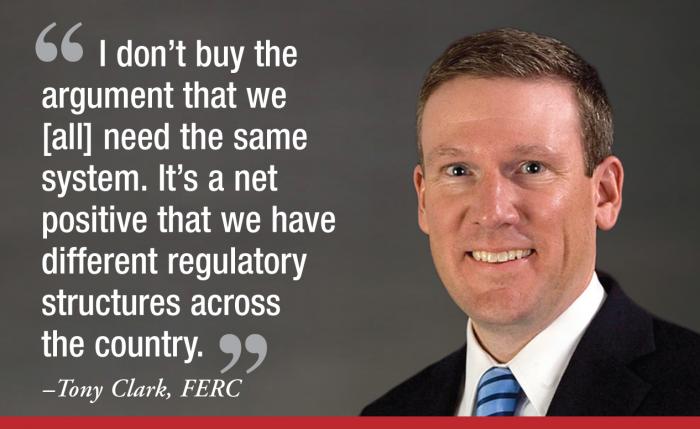 "I don’t buy the argument that we [all] need the same system. It’s a net positive that we have different regulatory structures across the country." - Tony Clark, FERC

Puente: As an industry, we’re very fragmented, and we’re dealing with the same federal regulations and, in many cases, with the same state regulators. We need more of a common front to deal with regulatory issues.
Rainwater: Unfortunately the gas pipeline infrastructure hasn’t kept pace with the build-out of gas-fired power generation in several regions. For example, the existing infrastructure in New England is inadequate to support both power generation and also space heating needs during the cold winter peak heating season, and it’s strained even during summer periods now. It’s fundamentally different to have a gas-fired power plant in New England that relies on regional gas supplies with limited deliverability [compared to] a mine-mouth coal-fired power plant where the supply is local and adequate and we ship the power over long distances via the electric transmission system.
[Also] I wonder if the growing dependence on IT infrastructure that’s at the core of our industry, where every major piece of equipment has an IP address, exposes us to unintended vulnerabilities. As well, the cost to remain current and avoid technological obsolescence from IT equipment is [rising] rapidly, and I wonder if this influence of IT in our sector could make the industry more vulnerable or fragile rather than more robust?
I have a growing concern about the fragility of the power grid over the next five years or so in some areas. And I worry that some kind of watershed event could occur – a regional brownout or blackout and the ensuing public outcry – and regrettably the local distribution company will likely get the brunt of the criticism.
New Moon Shot
 "Can the power industry help in some way by making clearer the risks and the effects that can result if policymakers continue down the current path?" - Peter Martin, Invensys
Puente: Making it all more difficult to manage is the fact that load isn’t growing. Few utilities are fortunate to have sustained growth, but if you aren’t growing, then you have to retire old plants, build new ones, remediate sites, build new transmission lines, and invest in smart grid systems etc., you keep piling costs onto a non-growing base.
Christian: In some ways we’re the victims of our own success. Electricity prices have been driven down so low, and reliability has remained relatively high.
Afonso: Public opinion drives public policy, and right now the public in the Northeast wants out of coal and isn't swayed by the possibility of reliability issues and resulting outages.
Peter Martin, Invensys: Public opinion to a certain extent is driven by emotion. The public has little time for rationalizing. Can the power industry help in some way by making clearer the risks and the effects that can result if policymakers continue down the current path?
 "The industry needs to continue to influence lawmakers – and to provide air cover when they step up." - Paul Afonso, Brown Rudnick
Rainwater: I wonder if we need something in our country analogous to [Pres. John F.] Kennedy’s challenge to land a man on the moon within a decade to spur development of a comprehensive, longer-term national energy policy that achieves, for example, energy independence within a decade. While it will be difficult it could be what it takes to galvanize various industries and move public opinion forward.
There’s a role for nuclear power and for scrubbed baseload coal generation in our country. There’s also a role for gas-fired generation, for solar, wind, hydro and other renewable technologies. And there’s a role for energy efficiency and demand response. In other words, we need a portfolio approach to our energy challenges and also we need a thoughtful long-term energy, economics, and environmental policy in our country. To develop such a comprehensive systems view will take courage and conviction and regrettably there doesn’t seem to be a lot of courage in this city [D.C.] to tackle such major policy challenges. I worry about this not only as an energy executive but also as a global citizen.
Looking at Blue Sky
Christian: What is your view on microgrids?
Rainwater: The military might need to be able to isolate from the grid and have self-sustained power generation to provide enhanced national security. I wonder if over the longer term this focus could shift to other industries as well, and if this trend will take hold over the next 10 to 15 years and fundamentally alter our business model.
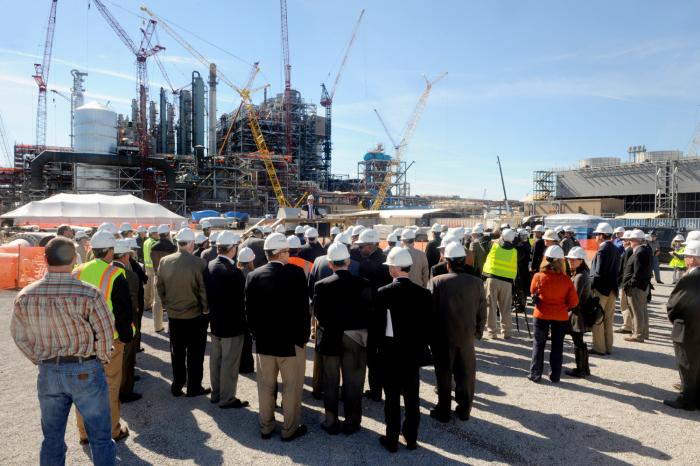 No new coal-fired power capacity is planned for construction in the U.S. today. Southern Company's Kemper project in Mississippi is one of the last being built, and it includes carbon capture and storage technology.
Burr: I’ve been doing a lot of work related to microgrids lately. One key point that’s becoming clearer is that a microgrid isn’t just one thing. Rather it’s whatever the customer needs it to be. Some customers need microgrids for energy assurance – resilient and reliable backup power supplies – and for others, mainly in developing countries, it’s a matter of access to electricity, period. In some places microgrids are a tool for optimizing the use of renewable energy to displace expensive diesel generation. There isn’t just one definition of ‘microgrid,’ because a microgrid can be a whole range of things to suit different needs and situations.
Another point is that microgrids will become more cost-effective, for a broader range of customers, as various technologies mature. Fuel cells, for example, are nearing grid parity faster than I ever would have expected. (See “Embracing Disruption: Developing a leadership role for utilities in alternative technologies”). Advances in software, microgrid control systems, and storage, all improve microgrid economics.
Martin: What we’re seeing in the electric power industry is happening in every industry, except slower. The real-time nature of managing electric power is increasing quickly. Electricity distribution is becoming more like information distribution.
Burr: What opportunities are arising from the changes that are happening in the industry? What do these changes mean for investment strategies?
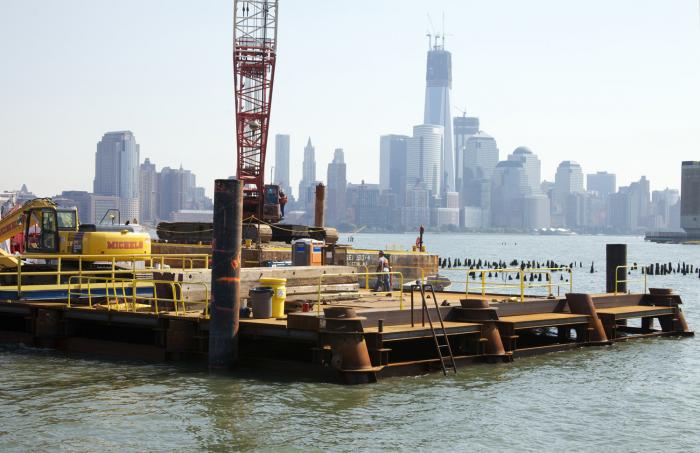 Industry leaders worry about inadequate gas supply into Northeast markets, especially with declining coal generation. Pictured: Spectra Energy’s NJ-NY Expansion project, beneath the Hudson River.
Rainwater: A ‘blue sky’ approach to development of strategy might be a hard sell to a board of directors who perceive it as too risky. Instead, there might well be a tendency to adopt more of an incremental approach to investments.
Afonso: Utilities need to be concerned about disintermediating trends. Customers use iPhones and products coming out of Silicon Valley, so they are receptive to new technologies. The sales cycle is different from what utilities are accustomed to, and capital needs are different. But scalability is key, and utilities can be an important partner at that table. Utilities can influence what customers really need. There’s a great opportunity there.
Puente: There’s a difference between wanting to grow your business and wanting to survive. You don’t want to jump out of the business you’re in and try something totally different. Some companies have tried it and lost their shirts.
Christian: The industry needs leaders capable of operating in a VUCA environment (volatility, uncertainty, complexity, and ambiguity). The need for this kind of leadership is a strategic issue.
Mind the Pendulum
Burr: Edison Electric Institute is talking about trying to bolster the perceived value of reliable electricity service. People don’t understand what it takes to deliver reliable electricity, and therefore they don’t properly value it. Will educating customers cause them to ascribe higher value to electricity, and therefore be willing to accept cost increases to pay for grid modernization and generation upgrades? Amid all this uncertainty and the drivers in the market, are we heading toward a future where reliability is a premium product that customers must pay for separately?
Bouknight: If that happens, then it becomes a contest between the haves and have-nots.
Puente: Reliability is a very subjective term. We can have the highest reliability numbers ever, and some customers will say we’re failing. Different parts of the country have different levels of reliability. If you live in the city, then you have multiple lines serving your home or business. Outside the city, you might only have one line.
Also telecommuting creates commercial load in residential areas. You’re now dealing with a lot of business customers in the residential neighborhood.
Christian: Some people pay extra for reliability already. Data centers have, in the past, requested redundant transmission-level service.

Afonso: Reliability affects business, and that affects local economies and politics. The CEO of a pharmaceutical company called me one evening and explained that outages were causing quality problems and major costs when product runs were lost. He said if he couldn’t get the problem resolved he would leave the state and take 320 jobs with him. In the big scheme of things, 320 jobs doesn’t sound like much, but in a local community that is a major economic blow.
Reliability also has bigger political ramifications. In 2004 leaders in the State of Massachusetts were talking about the interdependence of gas and electricity, and what it could mean for reliability especially during a cold snap. Here we are in 2013 and this remains an important issue that still needs to be resolved.
Christian: It’s getting worse. This is why NERC and most of the ISOs are taking a fresh look at the importance of fuel diversity as it relates to long-term reliability of electric service.
Afonso: Part of the problem is that some environmental advocates are purists. The impacts of environmental policies must be of concern to all policymakers. The industry needs to continue to influence lawmakers – and to provide air cover when they step up. There are a lot of knee-jerk reactions that happen in politics, and we need to make sure some people at regulatory agencies can bring a reality check to the decisions that are being taken. Eventually the pendulum is coming back.
