
Next-Gen Nuclear
Tomorrow’s options for low-carbon baseload generation.
The nuclear renaissance might be postponed, but technologies continue advancing. The next generation of plants will apply innovation for safety, efficiency, and modularity.


Tomorrow’s options for low-carbon baseload generation.

Indian Point and the battle for the nation’s energy future.
State lawmakers are trying to block relicensing of the Indian Point nuclear power plant near New York City, but the owner hopes to keep the plant generating low-cost electricity. The battle over Indian Point raises new legal issues—and represents a microcosm of the struggle for America’s nuclear future.

(December 2011) Responding to Contributing Editor John Bewick’s analysis of factors impeding the nuclear renaissance in the wake of the Fukushima disaster. Plus comments about construction work in progress provisions as a strategy for saving ratepayers' money.
Renewing public support after Fukushima Daiichi.
The Fukushima disaster has fallen off the headlines, but fear of nuclear energy remains a potent barrier to new development—as well as continued operation of the current reactor fleet. Building the foundation for a stable industry will require a sustained and strategic approach to restoring and securing the public trust.

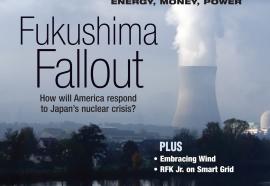
Fukushima shockwaves hit America’s nuclear renaissance.
In the aftermath of the March 11 earthquake and tsunami, questions are arising about the safety and survivability of reactors located in geologically active areas. Major changes might be required, and as a result the U.S. nuclear industry might face an existential challenge on the order of the Three Mile Island accident.
Only the fittest solutions survive in America’s policy wilderness.
All things being equal, momentous events like the Fukushima nuclear disaster and the Arab spring would bring fundamental changes in U.S. energy policy. But things aren’t equal, and they never will be under America’s democratic and capitalistic process. Frustrating? Maybe, but it’s the only way to ensure our decisions are based on sound economic and environmental principles.
Life, death and nuclear fallout.
Because we can’t define the consequences of nuclear accidents — and because radioactivity is invisible and undetectable without a Geiger counter — nuclear power’s risks are like shadowy monsters of unknown proportions, inspiring irrational fear. But that’s no excuse for complacency. Learning the lessons of Fukushima-Daiichi requires first acknowledging that we might have overestimated our ability to manage nuclear risks.

Avoiding pitfalls, realizing benefits.
Unlike the first generation of domestically sourced plants, new reactors being built in America will draw from a global supply chain for a wide range of materials, equipment and services. This poses a more complex set of challenges, from obtaining talent and material to qualifying and validating product sources.

Ring-fencing after the subprime meltdown.
When Électricité de France stepped in to buy Constellation Energy’s nuclear assets and help the company avoid bankruptcy, the Maryland Public Service Commission conditioned the sale on a set of ring-fencing provisions. The industry has been using such structures to protect ratepayers in complex and high-risk M&A transactions since the 1990s. The protection isn’t foolproof, however—and it can bring problematic regulatory trade-offs.
Can a broadly based committee resolve the nuclear waste dilemma?
The Department of Energy assembled an all-star Blue Ribbon Commission on America’s Nuclear Future. With such political and industry heavyweights as Brent Scowcroft, Lee Hamilton and John Rowe, the commission must be taken seriously. But can a broadly focused committee finish the decades-long battle to close the nuclear fuel cycle?